Posts for: #2024

Netmaker Releases Version 0.22.0 of WireGuard Mesh VPN

Netmaker Releases Version 0.22.0 of WireGuard Mesh VPN

Netmaker has announced the release of version v0.22.0 of its WireGuard mesh VPN software. One of the key features of Netmaker is its ability to automate virtual networks between data centers, clouds, and edge devices. This eliminates the need for manual configuration and allows for easy scalability.

The latest version introduces several new features and improvements. Some of the highlights include:

  • Revamped Internet Gateways
  • MQ fallback
  • Deprecating TURN in favor of failover hosts on Pro
  • Switch to CoreDNS for DNS resolution
  • DNS is no longer managed with the OS hosts file (/etc/hosts file)
  • Added support for RAC on mobile

In addition to the new features, version v0.22.0 also addresses several bugs and issues found in previous versions. Some of the fixes include:

  • Expired nodes not getting deleted
  • nmctl acl subcommand leading to a dirty state
  • Enforce private network ranges
  • Minor bugs and enhancements with user management
  • Scalability issues

SQLite 3.45 Updates JSON Functions for JSONB Usage

SQLite 3.45 has been released, and it brings several improvements to the popular SQL database library. One major enhancement is the optimization of the SQLITE_DIRECT_OVERFLOW_READ feature, which is now enabled by default. This optimization can significantly improve the read performance for applications that heavily rely on SQLite and read large BLOBs or strings. Another, perhaps more exciting update in SQLite 3.45 is the rewriting of all JSON functions to utilize the JSONB format. The JSONB version of SQLite’s JSON functions offers several times better performance compared to the existing JSON support within SQLite.

JSONB is a new internal-use binary representation of JSON that is stored as an SQL BLOB. This format allows SQLite’s internal binary representation of JSON to be directly stored in the database, eliminating the overhead of parsing and rendering JSON when reading and updating JSON values. Furthermore, the JSONB format takes up slightly less disk space than text JSON.

Source: Phoronix.

AYANEO AM02: Retro Mini PC with Ryzen 7 7840HS Processor and Vintage Console Design

AYANEO AM02: Retro Mini PC with Ryzen 7 7840HS Processor and Vintage Console Design

AYANEO, a company known for making handheld gaming PCs, has announced the AYANEO AM02, a small computer with a retro console design. The PC takes inspiration from the NES and SNES, featuring a boxy shape and color scheme reminiscent of classic gaming consoles. AYANEO recently unveiled the design and has now provided details about the hardware in preparation for an upcoming Indiegogo crowdfunding campaign.

The AYANEO AM02 is powered by an AMD Ryzen 7 7840HS processor, a 35-54 watt CPU with 8 AMD Zen 4 CPU cores, 16 threads, and clock speeds up to 5.1 GHz. Although typically used in gaming laptops paired with discrete GPUs, the AM02 features an integrated Radeon 780M GPU, boasting 12 RDNA 3 GPU cores with speeds up to 2.7 GHz.

Source: Liliputing.

Libvirt 10.0 Enhances QEMU VM Migration

Libvirt, a virtualization API managing virtualization on Linux, has released version 10.0. This update brings several new features, particularly in its QEMU support.

One notable addition in libvirt 10.0 is the postcopy-preempt migration capability. This feature allows for faster migration of memory pages by ensuring that the destination reads them before they are migrated from the source. Regarding QEMU, libvirt 10.0 introduces support for mapping I/O threads to virtqueues of virtio-blk devices. It also provides automatic resizing of block-device-backed disks to match the full size of the device. Additionally, libvirt 10.0 includes automatic selection and binding of VFIO variant drivers, as well as a runtime configuration option for nbdkit.

Other improvements in libvirt 10.0 include enhancements to the migration XML usage when persisting VM on the destination. It also simplifies non-shared storage migration to raw block devices, supports hotplug/unplug of PCI devices within the test driver, and includes various bug fixes.

Source: Phoronix.

KVM Enhancements in Linux 6.8

Changes to KVM virtualization in the upcoming 6.8 version of the Linux kernel include many new features and improvements. These changes are set to enhance the support for confidential VMs and bring various enhancements for KVM on different architectures.

Some of notable changes in the Linux 6.8 KVM include:

  • Improved support for confidential VMs: With the introduction of the KVM_SET_MEMORY_ATTRIBUTES ioctl, user-space can now specify per-page attributes for guest memory. This feature is particularly useful for confidential and secure VMs that utilize technologies such as AMD SEV-SNP, TDX, and ARM pKVM.
  • Software-protected VMs on x86: The KVM on x86 architecture now supports “software-protected VMs,” which allows for testing new interfaces related to guest_memfd and page attributes.
  • Flush-by-ASID support: KVM now unconditionally advertises flush-by-ASID support for nSVM, enabling the latest versions of VMware Workstation to run smoothly on KVM.
  • Linear Address Masking (LAM) for KVM guests: Linux 6.8 introduces support for LAM in KVM guests, enhancing the performance and security of virtualized environments.
  • CONFIG_KVM_HYPERV option: A new Kconfig option, CONFIG_KVM_HYPERV, allows users to disable KVM support for Microsoft Hyper-V emulation during the build process.
  • ARM64 LPA2 support: KVM now includes support for ARM64 LPA2, further expanding its capabilities on the ARM architecture.
  • LSX/LAX SIMD CPU instructions on LoongArch: KVM on LoongArch architecture now allows for the LSX/LAX SIMD CPU instructions within KVM guest VMs.

Source: Phoronix.

MINISFORUM HX200G: Mini PC with Ryzen 9 794HX and Radeon RX 7600M XT Graphics

MINISFORUM HX200G: Mini PC with Ryzen 9 794HX and Radeon RX 7600M XT Graphics

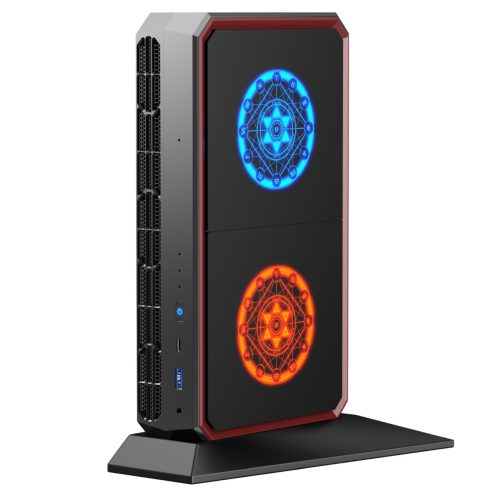
The MINISFORUM HX200G is a compact computer that boasts the powerful components typically found in gaming laptops. Revealed at CES 2024, this computer features a relatively powerful CPU, the AMD Ryzen 9 7945HX 16-core, 32-thread processor and an AMD Radeon RX 7600M XT discrete GPU RDNA 3 with 32 compute units. The MINISFORUM HX200G is one of the first mini PCs to support PCIe Gen 5 NVMe SSDs.

While pricing and detailed specifications have yet to be announced, promotional pictures reveal the presence of at least one USB-C port, one USB-A port, an audio jack, a power button, a large vent, and what appears to be a microphone array on the front of the device. The MINISFORUM HX200G could be an interesting option for machine learning workloads, if it’s possible to get ROCm working on the unit.

Source: Liliputing.