Posts for: #5g

5G M.2 to Ethernet and USB Converter by Waveshare Released

5G M.2 to Ethernet and USB Converter by Waveshare Released

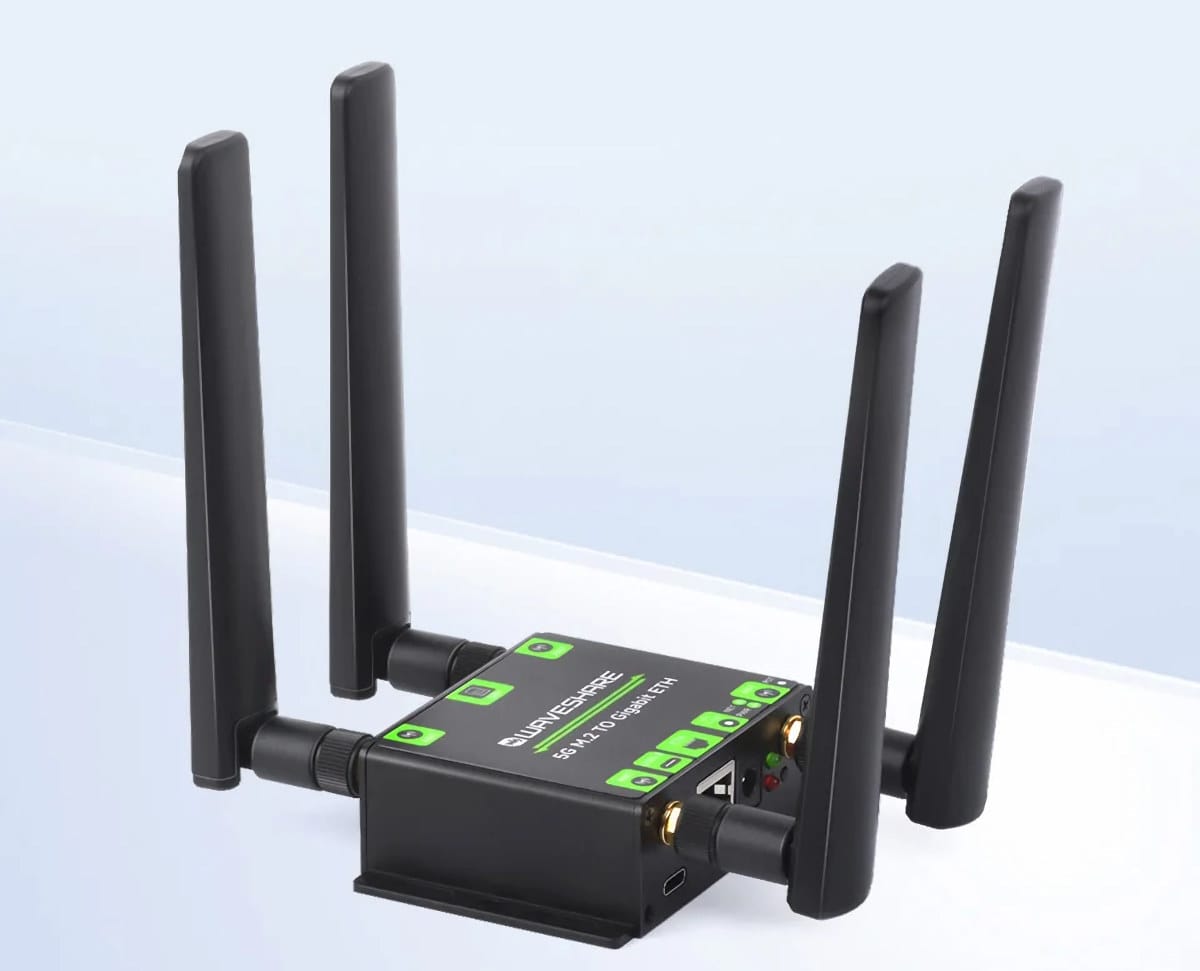
Waveshare has released a new device called the 5G M.2 TO Gigabit ETH, which allows for easy and cost-effective addition of 5G connectivity to a local area network (LAN) through a gigabit Ethernet port or to a specific host device such as a PC or Raspberry Pi SBC through a USB 3.1 Type-C port.

This converter is designed to be flexible, as it does not come with a built-in 5G module. Instead, it features an M.2 Key-B socket that is compatible with 3042 or 3052 5G modules from SIMCom, Quectel, and Fibocom. This allows users to select a module that meets their specific location requirements.

Key features and specifications of the 5G M.2 to Ethernet and USB converter include:

  • Cellular:
    • M.2 Key B socket for 3042/3052 5G modules
    • Onboard standard SIM card slot
    • 4x 5G omnidirectional high-gain antennas
  • Ethernet: Gigabit Ethernet RJ45 port using RealTek RTL8125 controller
  • USB: USB 3.1 Type-C port for connection to a PC, Raspberry Pi, or Jetson SBC for 5G networking or debugging
  • Misc: Power and Network LEDs, Reset button
  • Power Supply:
    • 9-12V DC via 5.5mm power barrel jack
    • 5V/2A power supply via USB-C port
  • Dimensions: 86.2 x 61.5 x 27.20 mm (excluding antenna connectors) with an aluminum alloy enclosure

If a variant without a built-in 5G module is purchased, users will need to select a suitable M.2 5G 3042 or 3052 module for their country. Waveshare provides recommendations for various models in a table on their website.

Users can choose to use USB for a direct connection to a host device or Ethernet for a direct connection or in router mode. Both Ethernet and USB modes can be used simultaneously.

The converter is available for purchase from Waveshare. The package includes a 12V power supply adapter, a USB-C cable, and antennas. Bundles with different 5G modules and heatsinks are also available. Additionally, Waveshare sells a standalone 5G M.2 to USB converter.

Source: CNX Software – Embedded Systems News.

Raspberry Pi 5 Introduces 5G Modem HAT with Quectel RM502Q-AE M.2 Module

Sixfab has introduced a 5G Modem Kit designed for the Raspberry Pi 5, featuring the Quectel RM502Q-AE 5G Sub-6GHz M.2 module, a proprietary internal antenna for Sub-6 frequency bands, and a USB 3.0 bridge connector. The Sixfab 5G Modem Kit for Raspberry Pi 5 includes a variety of specifications:

  • Sixfab 5G Modem HAT for Raspberry Pi 5
    • M.2 socket for 5G module
    • Nano SIM card holder + embedded SIM
    • USB 3.0 port and 40-pin GPIO header for connection to the Raspberry Pi 5 SBC
    • Misc
      • User button
      • Status, power, and user (GPIO21) LEDs
      • EEPROM for Raspberry Pi HAT compliance
      • 2-pin fan connector
    • Power Supply – 5V via USB Type-C port (on HAT itself)
    • Dimensions – 88.1 x 57.7 x 21.7 mm
    • Approvals – FCC, IC, CE, UKCA are in progress
  • Quectel RM502Q-AE M.2 module
    • 5G NR: 3GPP Release 15 NSA/SA operation, Sub-6 GHz
    • LTE Category: DL Cat 20/ UL Cat 18
    • Max data rates
      • 5G SA Sub-6 – Max. 4.2 Gbps (DL)/Max. 450 Mbps (UL)
      • 5G NSA Sub-6 – Max. 5 Gbps (DL)/Max. 650 Mbps (UL)
    • Host interfaces – USB 3.1 or PCIe 3.0
    • Dimensions – 52 x 30.0 × 2.3mm
    • Weight – 8.4 grams
  • Extra tall 40-pin GPIO stacking header
  • Power Supply – 5.1V 3.0A DC power adaptor with universal plugs
  • Plastic spacer kit

The kit, priced at $450, is compatible with various boards and computers, including the NVIDIA Jetson Nano Developer Kit, Beaglebone SBC, Asus Tinkerboard, NXP i.MX 8 devkits, and regular PCs, offering drivers and tools for both Windows and Linux. Additional components required for operation include a Raspberry Pi 5, a microSD card for the OS, a 5G SIM card (unless using the eSIM is an option), and an extra 5V USB-C power supply to separately power the Raspberry Pi 5 and Sixfab HAT.

Source: CNX Software – Embedded Systems News.