Posts for: #amd-ryzen

AMD Unveils New Ryzen 8000G Series APUs

AMD has unveiled its Ryzen 8000G series APUs at CES 2024. The Ryzen 8000G series processors are built on Zen 4 architecture and feature integrated Radeon 700M RDNA3 graphics. This marks the first time that Ryzen AI is included in such processors.

The Ryzen 7 8700G, offers 8 cores and 16 threads with a boost clock of up to 5.1GHz, 24MB cache, and a 65 Watt TDP. It is priced at $329 USD. The Ryzen 5 8600G provides 6 cores and 12 threads, with a boost clock of up to 5.0GHz, 22MB cache, and a 65 Watt TDP. It is priced at $229 USD. Additionally, there is a Ryzen 5 5500G with 6 cores and 12 threads, a 3.5GHz base clock, and a price of $179 USD. Finally, the Ryzen 3 8300G, which offers 4 cores and 8 threads, a 12MB cache, and a 65 Watt TDP. The pricing for this model has not been disclosed yet. Notably, the Ryzen 5 8500G and Ryzen 3 8300G consist of a combination of Zen 4 and Zen 4C cores.

During the press presentation, AMD emphasized the significance of Ryzen AI. Although Ryzen AI support for Linux is not publicly available yet, there are indications that it may be coming in the future.

Source: Phoronix.
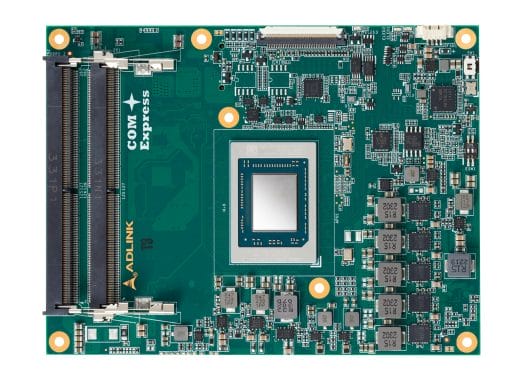
ADLINK AMD Ryzen Embedded V3000 COM Express Type 7 Module: Supports 64GB DDR5 Memory

ADLINK AMD Ryzen Embedded V3000 COM Express Type 7 Module: Supports 64GB DDR5 Memory

ADLINK has introduced the Express VR7, a COM Express Basic size Type 7 computer-on-module that is powered by the eight-core AMD Ryzen Embedded V3000 processor. The module features two 10GbE interfaces, fourteen PCIe Gen 4 lanes, and optional support for an “extreme temperature range” between -40°C and 85°C.

The ADLINK Express VR7 supports up to 64GB dual-channel DDR5 SO-DIMM memory (ECC/non-ECC). It is designed for headless embedded applications such as edge networking equipment, 5G infrastructure at the edge, video storage analytics, intelligent surveillance, industrial automation and control, and rugged edge servers.

Specifications:

  • SoC: AMD Embedded Ryzen V3000
    • Ryzen V3C48 8-core/16-thread processor @ 3.3/3.8GHz; TDP: 45W
    • Ryzen V3C44 4-core/8-thread processor @ 3.5/3.8GHz; TDP: 45W
    • Ryzen V3C18I 8-core/16-thread processor 1.9/3.8GHz; TDP: 15W (useful in the extreme temperature range)
    • Ryzen V3C16 6-core/12-thread processor 2.0/3.8GHz; TDP: 15W
    • Ryzen V3C14 4-core/8-thread processor 2.3/3.8GHz; TDP: 15W
  • System Memory: Up to 64GB (2x 32GB) dual-channel ECC/non-ECC DDR5 memory up to 4800 MT/s via two SODIMM sockets
  • On-module chips:
    • Embedded BIOS: AMI UEFI with CMOS backup in 32 or 16MB (TBC) SPI BIOS (dual BIOS by build option)
    • Intel i226 2.5GbE controller
  • 2x 220-pin connectors with:
    • Storage: 2x SATA III 6 Gbps
    • Networking:
      • 2x 10GBASE-KR and its sideband signals
      • 1x 2.5GbE interface
    • USB: 4x USB 3.x/2.0/1.1
    • Expansion buses:
      • 8x PCI Express Gen4: Lanes 16-23 (configurable to one x8, two x4, two controller)
      • 4x PCI Express Gen4: Lanes 0-3 (configurable to four x1, two x2, one x4, four controller)
      • 2x PCI Express Gen4: Lanes 4-5 (configurable to one x1, one x2, one controller)
      • LPC bus (through an ESPI to LPC bridge IC), SMBus (system), I2C (user), GP_SPU (user, project basis)
    • Serial: 2x UART ports with console redirection
    • IOs: 4x GPO and 4x GPI (with interrupt)
  • SEMA Board Controller: Voltage/current monitoring, power sequence debug support, AT/ATX mode control, logistics and forensic information, flat panel control, general purpose I2C, watchdog timer, fan control and failsafe BIOS (dual BIOS by build option)
  • Optional IPMB (in conjunction with carrier BMC for remote management Controller applications) by build option
  • Super I/O: Supported on carrier if needed (standard support for W83627DHG-P, other Super I/O supported on request)
  • Debug Headers: 40-pin multipurpose flat cable connector for use with DB40-HPC debug module providing BIOS POST code LED, EC access, SPI BIOS flashing, power testpoints, debug LEDs
  • Security: Infineon TPM 2.0 (SPI based)
  • Power Management:
    • Standard Input: ATX: 12V±5% / 5Vsb ±5%; or AT: 12V±5%
    • ACPI 5.0 compliant
    • Power States: C1-C6, S0, S1, S3, S4, S5, S5 ECO mode (Wake on USB S3/S4, WOL S3/S4/S5)
  • Dimensions: 125 x 95 mm (PICMG COM.0: Rev 3.1 Type 7 Basic size)
  • Temperature Range:
    • Operating: Standard: 0°C to 60°C; Extreme Rugged: -45°C to 85°C (build option, selected SKUs)
    • Storage: Standard: -20°C to 80°C; Extreme Rugged: -40°C to 85°C
  • Humidity:
    • 5-90% RH operating, non-condensing
    • 5-95% RH storage (and operating with conformal coating)
  • Shock and Vibration:
    • IEC 60068-2-64 and IEC-60068-2-27
    • MIL-STD-202F, Method 213B, Table 213-I, Condition A and Method 214A, Table 214-I, Condition D
  • HALT: Thermal Stress, Vibration Stress, Thermal Shock and Combined Test

ADLINK provides standard support for Yocto Linux and Ubuntu 20.04.3 LTS, as well as extended support for Yocto Project-based Linux. The company plans to offer I-Pi development kits based on the Express-VR7 module for easy prototyping and evaluation.

The availability of the Express-VR7 COM Express module based on the AMD Ryzen Embedded V3000 SoC has not been confirmed at this time. Additional details can be found on the product page.

Source: CNX Software – Embedded Systems News.

AOC Unveils MOSS 7 Mini PC Featuring Ryzen 7 7840HS in China

Chinese electronics company AOC has introduced a new mini PC called the AOC MOSS 7, featuring an AMD Ryzen 7 7840HS processor, 32GB of RAM, and a 2TB SSD. Currently, it is available for purchase in China through JD.com for 3799 CNY (approximately $525). The availability of this mini PC outside of China is uncertain, but AOC does sell other mini PCs internationally through AliExpress.

The AOC MOSS 7 has a unique design with rounded edges, resembling a game console or appliance rather than a typical PC. With dimensions of 145 x 115 x 42mm. Although it does not have discrete graphics, it is equipped with Radeon 780M integrated graphics, featuring 12 RDNA 3 compute units, providing graphics capabilities similar to some powerful handheld gaming PCs.

The mini PC offers user-replaceable memory with two SODIMM slots for DDR5 RAM. It also includes a variety of ports, such as 2 x HDMI 2.0, 1 x RJ45 LAN, 1 x USB Type-C, 3 x USB 3.0 Type-A, 1 x USB 2.0 Type-A, 1 x 3.5mm audio, and 1 x DC power input. Active cooling is provided by a fan, and the package includes a 68W power adapter. The MOSS 7 supports WiFi 6 and Bluetooth 5.2.

While the USB-C port should support video output and data transfer, there is no information available regarding whether it is a USB4 port with 40 Gbps speeds. Thus, it remains unclear if the port can be used for external graphics docks or other accessories requiring a higher-speed connection.

Source: Liliputing.

GEEKOM A5 Mini PC with AMD Ryzen 7 5800H

GEEKOM has released the A5, a mini PC powered by an AMD Ryzen 7 5800H processor, with 32GB RAM and a 512GB SSD.

The GEEKOM A5 mini PC boasts impressive features, including support for up to four 4K displays through two HDMI 2.0 outputs and two USB-C (USB 3.2 Gen 2) ports. It also offers 2.5Gbps Ethernet and WiFi 6 networking capabilities. The mini PC is equipped with three USB 3.2 Gen 2 Type-A ports, one USB 2.0 port, and a 3.5mm audio jack.

Here are the detailed specifications of the GEEKOM A5 mini PC:

  • SoC – AMD Ryzen 7 5800H 8-core/16-thread processor up to 3.2 GHz / 4.4 GHz (Turbo) with 16MB cache, AMD Radeon Vega 8 Graphics; TDP: 35W
  • System Memory – 32GB RAM via dual-channel DDR4-3200 SODIMM
  • Storage:
    • 512GB M.2 2280 PCIe Gen 3×4 NVMe SSD, upgradable to 2TB NVMe or SATA SSD
    • 2.5-inch SATA HDD slot (7mm thick max) up to 2TB
    • Full-size SD card slot
  • Video Output:
    • 2 x HDMI 2.0 ports up to 4Kp60Hz
    • 2x DisplayPort via USB Type-C ports up to 8Kp30
  • Audio – 3.5mm audio jack, digital audio via HDMI and USB-C
  • Networking:
    • 2.5GbE RJ45 port
    • WiFi 6 and Bluetooth 5.2
  • USB:
    • 3x USB 3.2 Gen 2 Type-A ports
    • 1x USB 2.0 Type-A port
    • 2x USB 3.2 Gen 2 Type-C ports with DisplayPort alt mode
  • Misc – Power button, Kensington Lock slot
  • Power Supply – 19V/6.32A (120W Power Adapter) via DC jack
  • Dimensions – 117 x 112 x 49.2 mm
  • Weight – 652 grams

The GEEKOM A5 mini PC comes with an activated version of Windows 11 Pro and several accessories, including a user guide, a VESA mount, an HDMI cable, and a 120W power adapter. We had the opportunity to review a sample unit of the A5, and we can confirm that it utilizes a 512GB Lexar NVMe (PCIe Gen 3 x4) SSD, as shown in the teardown photos.

Overall, the GEEKOM A5 mini PC offers good specifications and features at an affordable price point. It seems like a good option for those interested in a low power server.

Introducing the PALMSHELL NeXT H2: Affordable 10GbE Micro Server

The PALMSHELL NeXT H2 is an affordable micro server and single-board computer (SBC) powered by an AMD Ryzen Embedded R1505G processor. It offers impressive networking capabilities with two 10GbE SFP+ cages and one 2.5GbE RJ45 port. The system also supports up to 32GB of RAM and has storage options including an M.2 NVMe SSD and two SATA drives. It features wireless connectivity options such as WiFi 6, Bluetooth 5.2, and the possibility of adding a 4G LTE or 5G module. These network features make it an interesting option for various homelab uses. Theoretically, the device could support ECC memory as the Ryzen Embedded R1505G has such support, but this is not mentioned in the specifications for the NeXT H2 specifications, although it is mentioned in the specifications for the CPU. It should be noted that such support also depends on motherboard and firmware, not just on the CPU.

The system is equipped with a customized copper heatsink and a 3000 RPM PWM speed control fan for efficient cooling. It can be powered by a 12V to 19V DC power supply. The PALMSHELL NeXT H2 is designed to support multiple operating systems, including Ubuntu, Arch Linux, Fedora, Debian, OpenWrt, Windows, pfSense, and ROS.

The SBC without memory, storage, or wireless connectivity starts at $199. The barebone model with a metal enclosure is priced at $249. Two models with 8GB RAM/256GB SSD and 16GB/512GB configurations, along with the Intel AX210NGW WiFi 6E/BT 5.2 module, are available for $299 and $349, respectively. Power supply is not included with any of the options.

Source: CNX Software – Embedded Systems News.

Improved Performance and Power Efficiency with Linux 6.5 and AMD P-State EPP Default for Ryzen Servers

Linux 6.5 now defaults to the AMD P-State EPP driver for Zen 2 and newer Ryzen systems, as long as the system supports ACPI CPPC. However, the AMD EPYC server processors still continue to use ACPI CPUFreq by default. Given the increasing interest in the AMD Ryzen 7000 series for budget and small-to-medium-sized business (SMB) servers, the performance impact of Linux 6.5 with more server workloads was analyzed.

Phoronix has tested the changes, and testing was conducted comparing the performance of Linux 6.4 against Linux 6.5, both out-of-the-box and using the Ubuntu Mainline Kernel PPA for easy reproducibility. The default change involves going from ACPI CPUFreq Schedutil to AMD P-State EPP with the powersave governor. Additional tests were done with the performance governor for maximum performance. AMD P-State is available on earlier Linux kernel versions but is not set to be used out-of-the-box until Linux 6.5 and later. The testing was done using the ASRock Rack 1U4LW-B650/2L2T, a 1U Ryzen AM5 server platform that supports Ryzen 7000 series processors and ECC memory. No other changes were made to the server during testing, except for swapping out the Linux kernel and running secondary tests with the performance governor. The CPU clock frequency differences in the automated system table were minimal and did not affect the testing results.

The article provides valuable insights for those interested in using Ryzen processors for server applications.

Source: Phoronix.