Posts for: #banana-pi

Banana Pi BPI-M6 SBC Showcases SenaryTech SN3680 Quad-Core Cortex-A73 AI Processor

Banana Pi BPI-M6 SBC Showcases SenaryTech SN3680 Quad-Core Cortex-A73 AI Processor

The Banana Pi BPI-M6 is a single board computer (SBC) that integrates the SenaryTech SN3680 SoC, which features a quad-core Arm Cortex-A73 processor, an Arm Cortex-M3 real-time core, an Imagination GE9920 GPU, and a Neural Processing Unit (NPU) capable of delivering up to 6.75 TOPS for AI tasks. This makes it an interesting choice for developers and enthusiasts interested in AI, for example.

The BPI-M6 comes equipped with 4GB LPDDR4 RAM and 16GB of eMMC flash storage, expandable up to 64GB. It offers a form factor and port layout reminiscent of the Raspberry Pi 4, including four USB ports, Gigabit Ethernet, a 40-pin GPIO header, a USB Type-C power port, and two micro HDMI ports. A standout feature is the provision of an HDMI input alongside the HDMI output, adding to its versatility.

Here are the detailed specifications of the Banana Pi BPI-M6:

  • SoC: SenaryTech SN3680 with:
    • CPU: Quad-core Arm Cortex-A73 processor up to 2.1GHz
    • MCU: Arm Cortex-M3 real-time security core @ 250MHz
    • GPU: Imagination PowerVR Series9XE GE9920 GPU
    • VPU: Supports 4Kp60 H265, H264, VP9, ​​VP8, AV1, MPEG-2 video decoding and dual 1080p60 H.264/VP8 video encoding
    • NPU: Up to 6.75 TOPS
    • Manufactured using a 12nm process
  • Memory: 4 GB LPDDR4
  • Storage: 16GB eMMC flash, expandable via microSD and SPI flash
  • Video & Audio Interfaces: Micro HDMI 2.1 output (4Kp60), MIPI DSI interface, Micro HDMI input
  • Networking: Gigabit Ethernet RJ45 port, optional WiFi via USB dongle
  • USB: 4x USB 3.0 ports
  • Expansion: M.2 Key E socket (PCIe + MIPI CSI), 40-pin header
  • Misc: SPI BOOT, UBOOT, Reset buttons, power and activity LEDs
  • Power Supply: 5V/3A via USB Type-C port
  • Dimensions: 92 x 60mm
  • Weight: 48 grams

Banana Pi provides support for Android and Ubuntu 20.04, along with a Linux SDK that includes Kernel 5.4 and Buildroot 2019.10. Despite showcasing impressive AI capabilities, the board’s NPU utilization is somewhat limited due to a lack of publicly available development tools from Synaptics for the Vivante VIP9000 NPU integrated within the SoC.

Source: CNX Software – Embedded Systems News.

Upcoming OpenWrt One/AP-24.XY: A Collaborative Router Board by OpenWrt and Banana Pi

OpenWrt developers are partnering with Banana Pi to develop the OpenWrt One/AP-24.XY router board. OpenWrt is a lightweight embedded Linux operating system that supports close to 1,800 routers and other devices. However, this will be the first router board developed directly by OpenWrt.

The board will be based on the MediaTek MT7981B (Filogic 820) SoC and MediaTek MT7976C dual-band WiFi 6 chipset. The preliminary specifications for the OpenWrt One/AP-24.XY board include a dual-core Cortex-A53 processor, 1GB of DDR4 memory, 128 MB of SPI NAND flash, 4 MB of SPI NOR flash, 2.5GbE and Gigabit Ethernet ports, dual-band Wi-Fi 6, USB 2.0 and USB Type-C ports, and a MikroBUS socket for expansion modules.

The stated goal is to keep the price of the board under $100. The OpenWrt One/AP-24.XY router board is expected to be launched in 2024. The schematics will be publicly available under an open-source license.

Source: CNX Software – Embedded Systems News.

Banana Pi BPI-R4: WiFi 7 Router Board Powered by MediaTek Filogic 880 Processor

Banana Pi has released a new WiFi 7 router board called the BPI-R4. This router board is powered by the MediaTek MT7988A (Filogic 880) quad-core Arm Corex-A73 processor. It features 4GB DDR4 RAM, 8GB eMMC flash, and 128MB SPI-NAND flash.

The BPI-R4 also includes two 10GbE SFP cages, four Gigabit Ethernet RJ45 ports, a USB 3.2 port, an M.2 socket for a 4G/5G modem or an NVMe SSD, and two mini PCIe slots with PCIe 3.0 to support WiFi 7.

The specifications of the Banana Pi BPI-R4 are as follows:

  • SoC: MediaTek MT7988A (Filogic 880) quad-core Arm Corex-A73 processor @ 1.8GHz with AI-powered packet accelerator
  • System Memory: 4GB DDR4
  • Storage: 8GB eMMC flash, 128MB SPI NAND Flash, microSD card slot, M.2 Key M for NVMe SSD
  • Networking: 2x 10GbE SFP cages, 4x Gigabit Ethernet RJ45 ports
  • USB: USB 3.2 port
  • Expansion: M.2 Key-B slot with USB 3.2 interface for 5G or 4G LTE connectivity, M.2 Key-M slot with 1-lane PCIe 3.0 for NVMe SSD, 2x mini PCIe slots with 2-lane PCIe 3.0 for Wi-Fi 7 NIC, 26-pin GPIO header for expansion
  • Debugging: 3-pin header for 3.3V serial console
  • Misc: Reset button, WPS button, bootstrap switch, RTC battery connector
  • Power Supply: 12V/5.2A or 19V/3.2A via DC jack, 20V DC input via header, optional PoE module (RT5400), 5V/12V output header
  • Dimensions: 148 x 100.5 mm
  • Weight: 250 grams

The Banana Pi BPI-R4 currently has three OpenWrt images available for eMMC, NAND flash, or microSD card boot. A Debian image is also in development. The board does not come with a WiFi 7 module by default but can support it through the two mini PCIe sockets.

The WiFi 7 iPA NIC Module, which can be added to the BPI-R4, is based on a four-chip design with MediaTek MT7996 (WiFi 7 tri-band BE19000 SoC), MT7995N (2.4 GHz WiFi), MT7977AN (6 GHz), and MT7977B (6 GHz).

The Banana Pi BPI-R4 is available for purchase on Aliexpress for $103.15, but the WiFi 7 card must be purchased separately. Coupon codes are available for discounts during the Black Friday promotion.

Overall, the Banana Pi BPI-R4 is a powerful WiFi 7 router board with a range of features and expandability options.

Source: CNX Software – Embedded Systems News.

Banana Pi BPI-M4 Zero: A Raspberry Pi Zero Clone with Allwinner H618 and Dual USB-C Ports

The Banana Pi BPI-M4 Zero is a small computer board that closely resembles the Raspberry Pi Zero in size and shape. However, it offers some notable differences, such as dual USB-C ports instead of micro USB ports and a more powerful processor.

The BPI-M4 Zero features an ARM Cortex-A53 quad-core processor, 2GB of LPDDR4 memory, and 8GB of eMMC flash storage. It also includes a Raspberry Pi-compatible 40-pin connector, making it compatible with a wide range of accessories.

Compared to the Raspberry Pi Zero, the BPI-M4 Zero boasts a 1.5 GHz Allwinner H618 processor, which is the same chip used in another Raspberry Pi Zero clone, the Orange Pi Zero 2W.

In terms of ports and connectors, the Banana Pi model includes a mini HDMI 2.0a port, two USB Type-C ports (one with support for 5V/3A power input), a microSD card reader, a 24-pin FPC connector (supporting USB 2.0, 100 Mbps Ethernet, and IR), a 40-pin header, and a WiFi 5 & BT 4.2 module. The board also features two status LED lights, a wireless antenna, and two hardware keys functioning as a reset button and a FEL button.

Measuring 65 x 30mm, the BPI-M4 Zero should fit in most cases designed for the Raspberry Pi Zero or similar boards.

Pricing and availability for the Banana Pi BPI-M4 Zero have not been announced yet. However, it is expected that the board will be priced under $20, which is typical for this kind of device.

Source: Liliputing.

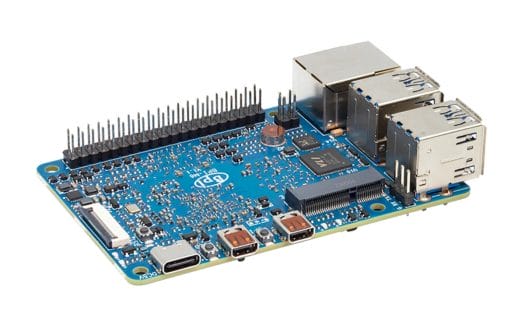
Banana Pi BPI-M7: Powerful RK3588 Chip, Dual 2.5 GbE Ethernet and PCIe NVMe SSD Support

The Banana Pi BPI-M7 is an upcoming single-board computer that offers impressive specifications and expansion options. Powered by a Rockchip RK3588 processor, the BPI-M7 boasts up to 32GB of RAM and up to 128GB of eMMC storage. It also supports WiFi 6 and Bluetooth 5.2.

What sets the BPI-M7 apart is its compact size and extensive expansion capabilities. With dimensions of just 92 x 62mm, it is comparable to a Raspberry Pi Model B. Despite its small size, the BPI-M7 can support up to three displays, has two 2.5 GbE Ethernet ports, and features an M.2 M-Key slot with PCIe 3.0 x4 NVMe SSD support.

The Rockchip processor at the heart of the BPI-M7 offers powerful performance, with four Cortex-A76 CPU cores running at 2.4 GHz, four Cortex-A55 cores running at 1.8 GHz, Mali-G610 MC4 graphics, and a neural processing unit with up to 6 TOPS of AI performance. The system also supports different memory and storage configurations, including 8GB, 16GB, or 32GB of LPDDR4x onboard memory and a 64GB or 128GB eMMC flash storage module.

In terms of connectivity, the BPI-M7 offers a range of ports and connectors, including USB Type-C with DisplayPort Alt Mode for up to 8K/30Hz output, HDMI 2.1 for 8K@60Hz display, and MIPI-DSI for 4K/60Hz display. It also features two 2.5 GbE Ethernet ports, an M.2 M-Key slot for PCIe 3.0 x4 NVMe SSD, a microSD card reader, USB 3.0 Type-A ports, MIPI-CSI camera connectors, a 40-pin GPIO header, a fan connector, and an audio header.

The Banana Pi BPI-M7 supports both Android 12 and Debian 10 “Buster” with Linux kernel 5.10. While mass production and pricing details are yet to be announced, the makers of the BPI-M7 have produced a small number of samples. With its powerful specifications and expansion options, the BPI-M7 looks promising for server enthusiasts, Linux users, DevOps professionals, and home lab enthusiasts.

Source: Liliputing.