Posts for: #cpu

AMD Unveils New Ryzen 8000G Series APUs

AMD has unveiled its Ryzen 8000G series APUs at CES 2024. The Ryzen 8000G series processors are built on Zen 4 architecture and feature integrated Radeon 700M RDNA3 graphics. This marks the first time that Ryzen AI is included in such processors.

The Ryzen 7 8700G, offers 8 cores and 16 threads with a boost clock of up to 5.1GHz, 24MB cache, and a 65 Watt TDP. It is priced at $329 USD. The Ryzen 5 8600G provides 6 cores and 12 threads, with a boost clock of up to 5.0GHz, 22MB cache, and a 65 Watt TDP. It is priced at $229 USD. Additionally, there is a Ryzen 5 5500G with 6 cores and 12 threads, a 3.5GHz base clock, and a price of $179 USD. Finally, the Ryzen 3 8300G, which offers 4 cores and 8 threads, a 12MB cache, and a 65 Watt TDP. The pricing for this model has not been disclosed yet. Notably, the Ryzen 5 8500G and Ryzen 3 8300G consist of a combination of Zen 4 and Zen 4C cores.

During the press presentation, AMD emphasized the significance of Ryzen AI. Although Ryzen AI support for Linux is not publicly available yet, there are indications that it may be coming in the future.

Source: Phoronix.
Zhaoxin Working on Linux Support for Preferred Core on Their CPUs

Zhaoxin engineers are developing preferred core support for their processors in the Linux kernel. Similar to Intel and AMD processors, Zhaoxin CPUs can have cores with different frequencies and maximum frequencies. The proposed Linux kernel patches will use existing ACPI functionality to indicate the per-core differences and will reflect that within the ACPI CPUFreq driver. This will allow the scheduler to prioritize running tasks on the preferred cores for improved performance.

Source: Phoronix.

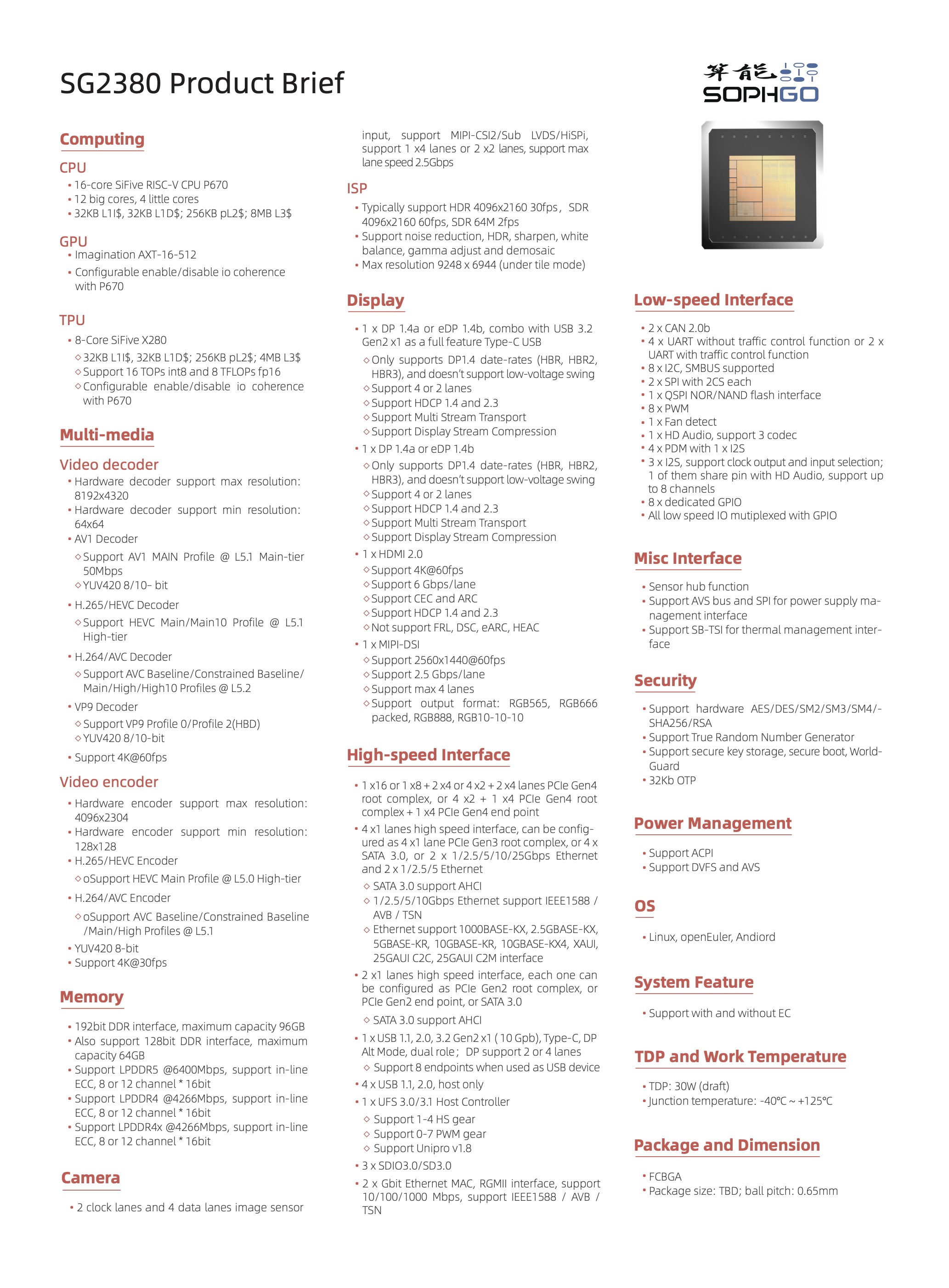
Sophgo SG2380 RISC-V SoC Expands RAM Support to 96GB, Adds PCIe and 25 GbE

Sophgo SG2380 RISC-V SoC Expands RAM Support to 96GB, Adds PCIe and 25 GbE

The Sophgo SG2380 RISC-V SoC has received an upgrade, according to a recent announcement by Milk-V. The SoC, which was previously announced in October, now supports up to 96GB of RAM, an increase from the previous limit of 64GB. The memory is now using a 192-bit interface. Additionally, the SG2380 has been upgraded with an additional PCIe x16 lanes and now supports up to 25 Gbps Ethernet. Milk-V has shared the upgraded specifications of the Sophgo SG2380 SoC on their website.

Overall, the upgraded capabilities of the Sophgo SG2380 RISC-V SoC are promising, and it will be interesting to see how it performs when it becomes available in the future.

Source: Phoronix.

AMD Unveils Powerful Ryzen Embedded 7000 Series Processors

AMD has unveiled its latest addition to the Zen 4 family, the Ryzen Embedded 7000 series processors. These socketed CPUs are designed for embedded and edge applications in the 60~105 Watt space. The Ryzen Embedded 7000 series processors offer significant improvements over the previous generation Ryzen Embedded 5000 series parts. They feature up to 12 cores and 24 threads, TDPs ranging from 65 to 105 Watts, support for DDR5-5200 ECC memory, up to 28 lanes on-chip for PCIe Gen5, and integrated RDNA2 graphics. AMD is committed to providing up to seven years of support for these processors. Linux, particularly Ubuntu, is the preferred operating system for these embedded processors.

The Ryzen Embedded 7000 series processors come with a range of models, from the Ryzen Embedded 7645 to the Ryzen Embedded 7700X. The flagship model, the Ryzen Embedded 7945, is a 65 Watt part with 12 cores, 24 threads, a base frequency of 3.7GHz, a boost frequency of 5.4GHz, and 64MB L3 cache. Unfortunately, there are no technical benchmarks available yet, but AMD claims significant performance advantages over Intel Raptor Lake on Windows.

The chipset options for the Ryzen Embedded 7000 series are the X600, B650, and X670. It is worth noting that these processors do not have Ryzen AI, although there is a possibility that future generations may support it on Linux.

Overall, the AMD Ryzen Embedded 7000 series processors offer a powerful and efficient solution for embedded and edge applications. With their improved performance and support for Linux, they are likely to find popularity in the embedded space.

Source: Phoronix.

MediaTek Dimensity 9300 Emphasizes “Big” Cores, Ditches Efficiency Cores

MediaTek has taken a different approach with its new Dimensity 9300 processor by opting for “big” cores instead of the usual big.LITTLE technology that combines high-performance cores with energy-efficient cores. This decision could make the Dimensity 9300 more competitive with flagship-class processors from Qualcomm and other companies. The chip features four Cortex-X4 CPU cores and four Cortex-A720 cores, which could give it an edge in tasks that utilize all eight CPU cores simultaneously. However, it is important to note that the CPU frequencies differ between MediaTek’s chip and Qualcomm’s Snapdragon chip, which has one Cortex-X4 core and five Cortex-A720 cores. Additionally, without lower-power cores, the energy efficiency of Qualcomm’s chip remains to be seen.

Specifications:

  • CPU:

    • MediaTek Dimensity 9300:
      • 1 x Cortex-X4 @ 3.25 GHz
      • 3 x Cortex-X4 @ 2.85 GHz
      • 4 x Cortex-A720 @ 2 GHz
    • Qualcomm Snapdragon 8 Gen 3:
      • 1 x Cortex-X4 @ 3.3 GHz
      • 3 x Cortex-A720 @ 3.2 GHz
      • 2 x Cortex-A720 @ 3 GHz
      • 2 x Cortex-A520 @ 2.3 GHz
  • GPU:

    • MediaTek Dimensity 9300: Immoratlis G720-MC12
    • Qualcomm Snapdragon 8 Gen 3: Adreno 740
  • RAM:

    • MediaTek Dimensity 9300: LPDDR5T (up to 9600 MB/s)
    • Qualcomm Snapdragon 8 Gen 3: LPDDR5x (up to 9600MB/s)
  • Wireless:

    • MediaTek Dimensity 9300:
      • WiFi 7 (6.5 Gbps)
      • Bluetooth 5.4
      • 5G Sub-6 GHz/mmWave (up to 7.9 Gbps)
    • Qualcomm Snapdragon 8 Gen 3:
      • WiFi 7 (5.8 Gbps)
      • Bluetooth 5.4
      • 5G Sub-6 GHz/mmWave (up to 10 Gbps)
  • Camera:

    • MediaTek Dimensity 9300:
      • Up to 320MP (single camera)
      • Up to 4K @ 60 fps (video)
      • Up to 8K @ 30 fps (video)
      • 18-bit ISP
    • Qualcomm Snapdragon 8 Gen 3:
      • Up to 200MP (single camera)
      • Up to 4K @ 120 fps (video)
      • Up to 8K @ 30 fps (video)
      • 18-bit ISP
  • Display:

    • MediaTek Dimensity 9300:
      • Up to 4K @ 120 Hz
      • Up to WQHD @ 180 Hz
    • Qualcomm Snapdragon 8 Gen 3:
      • Up to 4K @ 60 Hz
      • Up to QHD+ @ 144 Hz

MediaTek claims that the Dimensity 9300 offers several improvements over its predecessor, the Dimensity 9200, including faster CPU and GPU performance, as well as improved AI performance.

Source: Liliputing.

AMD Introduces Smaller Zen 4c CPU Cores in Latest Ryzen 7040U Mobile Chips

AMD has released its latest mobile chips, the Ryzen 5 7545U and Ryzen 3 7440U, which are the first laptop processors to feature AMD’s new Zen 4c CPU cores. These cores were previously seen in the EPYC server chips and the entry-level AMD Ryzen Z1 chip for handheld gaming PCs. The Zen 4c cores offer most of the same features as Zen 4 cores but take up less space and run at lower speeds. AMD claims that the Zen 4c cores take up 35% less physical space than Zen 4, allowing for more cores in the same amount of space or the same number of cores in a smaller space.

The Ryzen 5 7545U and Ryzen 3 7440U chips replace the previous Ryzen 5 7540U and Ryzen 3 7440U Phoenix chips. The new chips still have the same number of CPU cores (6 for Ryzen 5 and 4 for Ryzen 3), but now some of those cores are Zen 4c chips, which should bring efficiency improvements and similar performance at lower power levels. The top speeds for the Zen 4c cores are not known, but they are estimated to be about 30% slower than Zen 4 cores.

The updated Ryzen 7040U lineup includes the following chips:

  • Ryzen 7 7840U: 8 x Zen 4 cores, 8 / 16 cores / threads, 3.3 GHz / 5.1 GHz base / boost CPU frequency, 24MB cache, Radeon 780M graphics, DDR5 / LPDDR5 RAM, USB4 support, 15-30W TDP.
  • Ryzen 5 7640U: 6 x Zen 4 cores, 6 / 12 cores / threads, 3.5 GHz / 4.9 GHz base / boost CPU frequency, 22MB cache, Radeon 760M graphics, DDR5 / LPDDR5 RAM, USB4 support, 15-30W TDP.
  • Ryzen 5 7540U: 6 x Zen 4 cores, 6 / 12 cores / threads, 3.2 GHz / 4.9 GHz base / boost CPU frequency, 22MB cache, Radeon 740M graphics, DDR5 / LPDDR5 RAM, USB4 support, 15-30W TDP.
  • Ryzen 5 7545U: 2 x Zen 4 cores, 4 x Zen 4c cores, 6 / 12 cores / threads, 3.2 GHz / 4.9 GHz base / boost CPU frequency, 22MB cache, Radeon 740M graphics, DDR5 / LPDDR5 RAM, USB4 support, 15-30W TDP.
  • Ryzen 3 7440U (old): 4 x Zen 4 cores, 4 / 8 cores / threads, 3 GHz / 4.7 GHz base / boost CPU frequency, 12MB cache, Radeon 740M graphics, DDR5 / LPDDR5 RAM, USB4 support, 15-30W TDP.
  • Ryzen 3 7440U (new): 1 x Zen 4 core, 3 x Zen 4c cores, 4 / 8 cores / threads, 3 GHz / 4.7 GHz base / boost CPU frequency, 12MB cache, Radeon 740M graphics, DDR5 / LPDDR5 RAM, USB4 support, 15-30W TDP.

Source: Liliputing.