Posts for: #ethernet

Firefly EXT-2.5GE-RK3588-RT: Quad 2.5GbE Ethernet Expansion Board for ROC-RK3588-RT SBC

Firefly EXT-2.5GE-RK3588-RT: Quad 2.5GbE Ethernet Expansion Board for ROC-RK3588-RT SBC

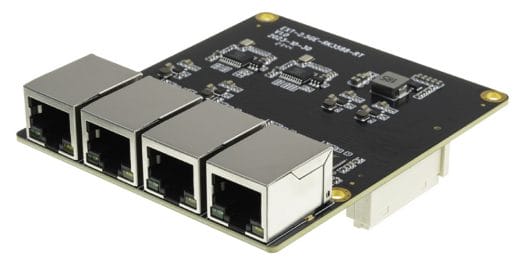
Firefly has launched the EXT-2.5GE-RK3588-RT, a 2.5GbE Ethernet Expansion Board for the ROC-RK3588-RT Rockchip RK3588 SBC. The ROC-RK3588-RT SBC already features three Ethernet ports, making it ideal for routers and firewalls. The EXT-2.5GE-RK3588-RT adds four more 2.5GbE ports to the SBC, bringing the total number of Ethernet ports to seven with five 2.5GbE and two GbE RJ45 jacks. The board uses the RTL8125BG IC for Ethernet control and the PI6C557-05 IC as a spectrum clock generator.

Source: CNX Software – Embedded Systems News.

The Sipeed Longan Pi3H: A Compact Board with Gigabit Ethernet, WiFi 6, HDMI, and USB

The Sipeed Longan Pi3H: A Compact Board with Gigabit Ethernet, WiFi 6, HDMI, and USB

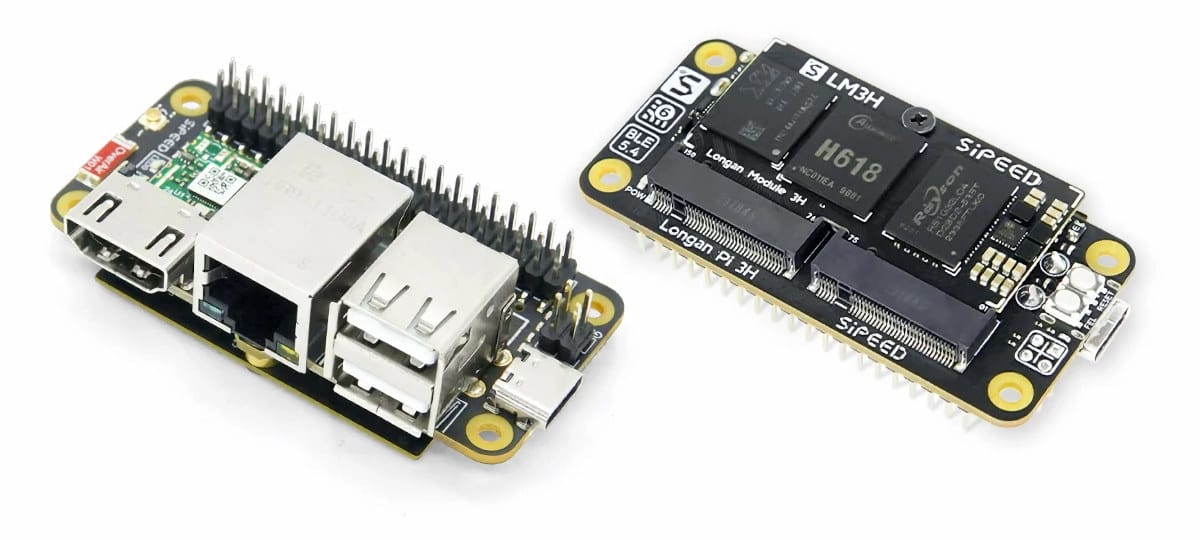
Sipeed has introduced the Longan Pi3H, a single board computer (SBC) that is similar in size to the Raspberry Pi Zero. Powered by an Allwinner H618 quad-core Cortex-A53 processor, the board features full-size connectors including an HDMI 2.0 video output, two USB 2.0 Type-A ports, and a gigabit Ethernet RJ45 jack. It also offers WiFi 6 and Bluetooth 5.4 connectivity, a 40-pin GPIO header, and a USB OTG Type-C port for power. The board is composed of a carrier board and a replaceable LM3H CPU module with the Allwinner H618 SoC, RAM, and eMMC flash.

The Sipeed Longan Pi3H specifications include:

  • SoC – Allwinner H618 with a quad-core Arm Cortex-A53 processor, up to 1.5GHz, and 1MB L2 cache
  • GPU – Arm Mali-G31 MP2 GPU with support for OpenGL ES 1.0/2.0/3.2, OpenCL 2.0, Vulkan 1.1
  • VPU with support for various video formats
  • System Memory – 2GB or 4GB LPDDR4
  • Storage options include a microSD card slot and optional 32GB eMMC flash
  • Video & Audio Output – HDMI 2.0a up to 4Kp60
  • Networking features a gigabit Ethernet RJ45 port and dual-band WiFi 6 and Bluetooth 5.4 with a ceramic antenna
  • USB ports include 2x USB 2.0 Type-A ports and 1x USB 2.0 OTG Type-C port
  • Expansion options include a 40-pin Raspberry Pi-compatible GPIO header with I2C, SPI, UART, and a variety of GPIOs
  • Debugging features a 4-pin debug UART (3.3V)
  • Additional features include FEL and Reset buttons, 2x user LEDs
  • Power supply options include 5V via USB Type-C port or 4-pin Debug UART header
  • Dimensions: SBC – 65 x 30.8 x 23.6 mm, LM3H module – 46.1 x 25 x 2.9mm

Mainline Linux support for the board is expected to be merged in Q1 2024. While the documentation page is not currently working, hardware documentation such as schematics and mechanical drawings are available.

Pre-orders for the Sipeed Longan Pi3H are available on Aliexpress, with prices ranging from $17.90 for the 2GB RAM variant (without eMMC flash) to $34.90 for the 4GB RAM variant with 32GB eMMC flash. Shipping is expected to start on February 11, and the product will be available for European customers in a few days.

Source: CNX Software – Embedded Systems News.

5G M.2 to Ethernet and USB Converter by Waveshare Released

5G M.2 to Ethernet and USB Converter by Waveshare Released

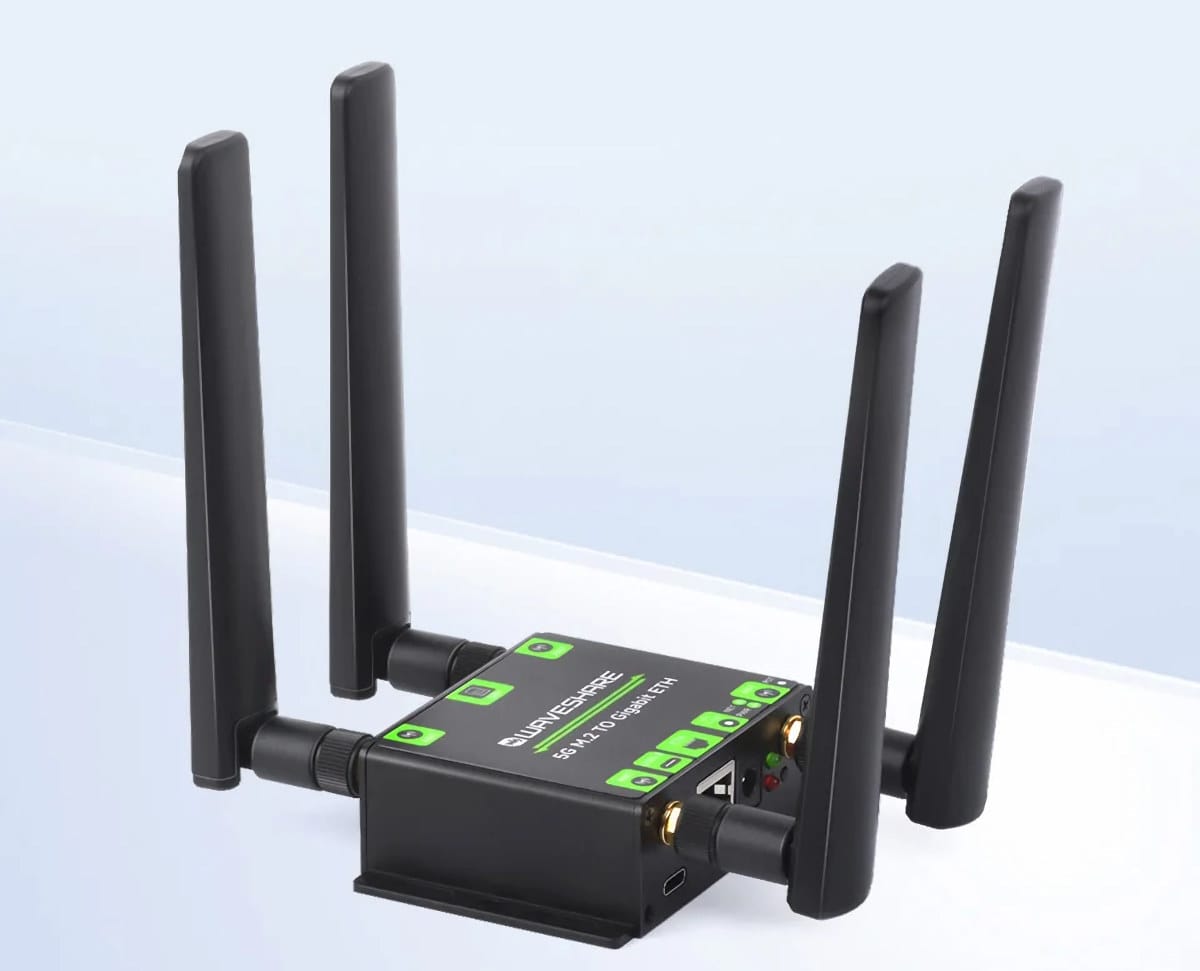
Waveshare has released a new device called the 5G M.2 TO Gigabit ETH, which allows for easy and cost-effective addition of 5G connectivity to a local area network (LAN) through a gigabit Ethernet port or to a specific host device such as a PC or Raspberry Pi SBC through a USB 3.1 Type-C port.

This converter is designed to be flexible, as it does not come with a built-in 5G module. Instead, it features an M.2 Key-B socket that is compatible with 3042 or 3052 5G modules from SIMCom, Quectel, and Fibocom. This allows users to select a module that meets their specific location requirements.

Key features and specifications of the 5G M.2 to Ethernet and USB converter include:

  • Cellular:
    • M.2 Key B socket for 3042/3052 5G modules
    • Onboard standard SIM card slot
    • 4x 5G omnidirectional high-gain antennas
  • Ethernet: Gigabit Ethernet RJ45 port using RealTek RTL8125 controller
  • USB: USB 3.1 Type-C port for connection to a PC, Raspberry Pi, or Jetson SBC for 5G networking or debugging
  • Misc: Power and Network LEDs, Reset button
  • Power Supply:
    • 9-12V DC via 5.5mm power barrel jack
    • 5V/2A power supply via USB-C port
  • Dimensions: 86.2 x 61.5 x 27.20 mm (excluding antenna connectors) with an aluminum alloy enclosure

If a variant without a built-in 5G module is purchased, users will need to select a suitable M.2 5G 3042 or 3052 module for their country. Waveshare provides recommendations for various models in a table on their website.

Users can choose to use USB for a direct connection to a host device or Ethernet for a direct connection or in router mode. Both Ethernet and USB modes can be used simultaneously.

The converter is available for purchase from Waveshare. The package includes a 12V power supply adapter, a USB-C cable, and antennas. Bundles with different 5G modules and heatsinks are also available. Additionally, Waveshare sells a standalone 5G M.2 to USB converter.

Source: CNX Software – Embedded Systems News.
QLogic 10Gb “QLGE” Ethernet Driver to be Removed from Linux Kernel

For those who have QLogic 10Gb PCIe Ethernet adapters, the mainline Linux kernel plans to remove the QLGE driver from the kernel source tree unless active users come forward to maintain it. QLogic was acquired by Cavium in 2016, and then Marvell acquired Cavium in 2018. Despite these acquisitions, there are still QLogic 10Gb Ethernet adapters on the market and in various servers.

The QLogic 10Gb Ethernet adapter can still be found on platforms like Amazon for around $75 USD. It has also been used in some Dell adapters. However, the QLGE driver is not being maintained, and it is currently planned for removal from the Linux kernel source tree.

The QLGE driver has been residing in the Linux kernel’s staging area, but there has been no activity since January 2021. Without anyone stepping up to maintain the driver and improve the code for integration into the networking subsystem, it is now scheduled for removal in Linux 6.7.

A patch to “retire” the QLGE driver has been queued in staging-next. If there are users of the QLogic 10Gb Ethernet hardware supported by this driver who are still using the latest upstream Linux kernel versions, they can make it known and the driver can be restored. However, if this does not happen, the driver removal will take place in the upcoming Linux 6.7 cycle.

Source: Phoronix.

Lilygo T-ETH-Lite: The ESP32-S3 Board with Ethernet and Optional PoE Support

CNX Software reports that LILYGO has released the T-ETH-Lite ESP32-S3, a development board that features WiFi, Bluetooth, and Ethernet connectivity.

The board includes a low-profile Ethernet RJ45 connector with a WIZnet W5500 Ethernet controller and supports Power over Ethernet (PoE) with an additional shield. It also comes equipped with a microSD card slot and expansion I/Os. The T-ETH-Lite ESP32-S3 is based on the ESP32-S3-WROOM-1 wireless module, which features an ESP32-S3 dual-core LX7 microprocessor running at up to 240 MHz and 8MB of PSRAM. It also has 16MB of SPI flash storage and supports WiFi 4 and Bluetooth 5 with LE/Mesh. The board has 2x 15-pin headers with up to 23x GPIOs, 2x UART, 14x ADC, touch interface, reset, 5V, 3.3V, and GND. It measures 59 x 28 x 11 mm.

LILYGO provides a range of Arduino samples for the T-ETH boards, including web server, firmware updates, MQTT server, and more. The T-ETH-Lite ESP32-S3 board is available now on AliExpress. In a home lab environment, the T-ETH-Lite ESP32-S3 with its Ethernet port and PoE support could probably be used to develop an interesting monitoring device, for example.

Source: CNX Software – Embedded Systems News.