Posts for: #networking

Compact Mini-ITX Motherboard with Ryzen 7 7840HS Processor, Four 2.5 GbE LAN Ports, and 9 SATA Drives

Compact Mini-ITX Motherboard with Ryzen 7 7840HS Processor, Four 2.5 GbE LAN Ports, and 9 SATA Drives

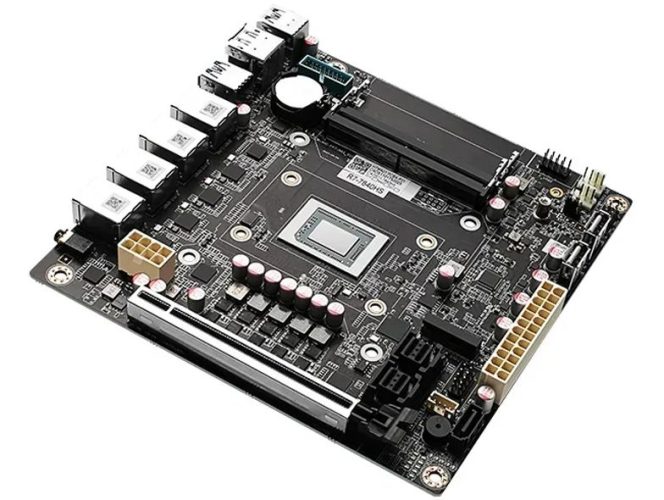
According to Liliputing, the Topton N11 mini-ITX motherboard, designed primarily for NAS builds, networking, and storage solutions, is now available. It incorporates a high-performance AMD Ryzen 7 7840HS processor and offers expansive storage and networking capabilities, making it an excellent choice for those interested in servers, Linux, DevOps, and home labs.

Specifications of the Topton N11 include:

  • Processor: AMD Ryzen 7 7840HS with 8 Zen 4 CPU cores, 16 threads, up to 5.1 GHz speeds, and a TDP range of 35-54W.
  • Graphics: AMD Radeon 780M integrated graphics with 12 RDNA 3 GPU cores.
  • AI Processing: AMD Ryzen AI neural processing unit with up to 10 TOPS.
  • Memory: 2 x DDR5-5600 SODIMM slots (dual-channel), supporting up to 64GB total.
  • Storage:
    • 2 x M.2 2280 slots for PCIe 4.0 x2 NVMe SSDs.
    • 1 x SATA 3.0 socket.
    • 2 x SFF-8643 sockets for 1 to 4 SATA 3.0 cables each, allowing up to 9 SATA drives in total.
  • Networking: 4 x Intel i226-V 2.5 Gbps RJ45 Ethernet ports.
  • Expansion: 1 x PCIe 4.0 x16 socket (PCie x8 signal).
  • Display Outputs: 1 x DisplayPort 1.4, 1 x HDMI 2.0.
  • USB Ports: 1 x USB4, 3 x USB 3.2 Type-A, plus internal USB 2.0 ports and a USB 3.2 signal pin.
  • Audio: 1 x 3.5mm audio jack.
  • Other Features: Support for up to three displays and up to 11 storage devices using M.2 slots and SATA connections. Includes an RTC battery.

The Topton N11 is currently retailing on AliExpress starting at $489. It measures 170 x 170mm, providing a compact yet powerful solution for various computing needs, particularly in networking and storage-focused setups. There’s also a hint of a forthcoming Ryzen 9 7940HS model, expanding options for users seeking even greater performance.

Source: Liliputing.

Netmaker Releases Version 0.22.0 of WireGuard Mesh VPN

Netmaker Releases Version 0.22.0 of WireGuard Mesh VPN

Netmaker has announced the release of version v0.22.0 of its WireGuard mesh VPN software. One of the key features of Netmaker is its ability to automate virtual networks between data centers, clouds, and edge devices. This eliminates the need for manual configuration and allows for easy scalability.

The latest version introduces several new features and improvements. Some of the highlights include:

  • Revamped Internet Gateways
  • MQ fallback
  • Deprecating TURN in favor of failover hosts on Pro
  • Switch to CoreDNS for DNS resolution
  • DNS is no longer managed with the OS hosts file (/etc/hosts file)
  • Added support for RAC on mobile

In addition to the new features, version v0.22.0 also addresses several bugs and issues found in previous versions. Some of the fixes include:

  • Expired nodes not getting deleted
  • nmctl acl subcommand leading to a dirty state
  • Enforce private network ranges
  • Minor bugs and enhancements with user management
  • Scalability issues

Qotom Q20332G9-S10: Fanless Mini PC with 4 10GbE and 5 2.5GbE Ports

Qotom Q20332G9-S10: Fanless Mini PC with 4 10GbE and 5 2.5GbE Ports

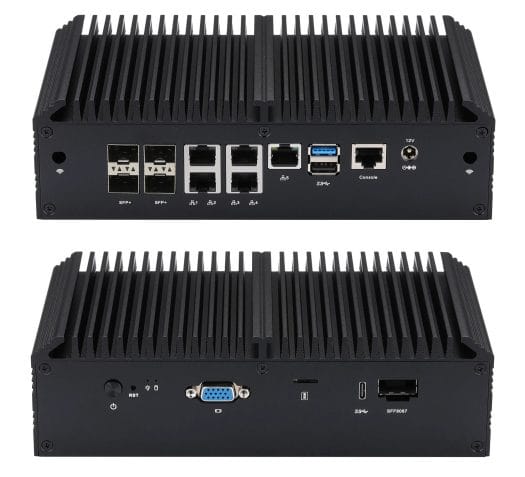
The Qotom Q20332G9-S10 is a fanless mini PC that can be sued as a router, due to the fact that it features four 10GbE SFP+ cages and five 2.5GbE RJ45 ports, making it a suitable network appliance. The system is powered by an Atom C3758R Denverton Refresh eight-core processor.

In terms of specifications, the Qotom Q20332G9-S10 supports up to 64GB DDR4 memory and has two M.2 NVMe SSD sockets, as well as two 2.5-inch SATA bays for storage. It also includes one extra M.2 socket for cellular connectivity and several USB ports. The system is equipped with a VGA port for video output.

The Qotom Q20332G9-S10 comes with a 12V/5A power supply and a VESA mount. It can be purchased as a barebone system or with pre-installed RAM and SSD. It is available for around $300 on Amazon and Aliexpress in its barebone configuration, with variants offering up to 64GB RAM and 2TB SSD.

Source: CNX Software – Embedded Systems News.

Firefly EXT-2.5GE-RK3588-RT: Quad 2.5GbE Ethernet Expansion Board for ROC-RK3588-RT SBC

Firefly EXT-2.5GE-RK3588-RT: Quad 2.5GbE Ethernet Expansion Board for ROC-RK3588-RT SBC

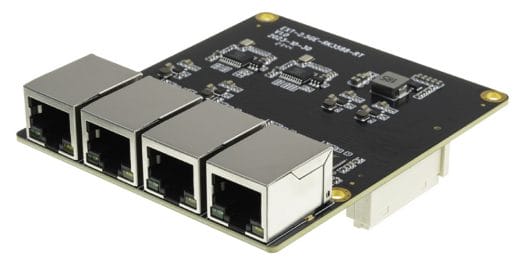
Firefly has launched the EXT-2.5GE-RK3588-RT, a 2.5GbE Ethernet Expansion Board for the ROC-RK3588-RT Rockchip RK3588 SBC. The ROC-RK3588-RT SBC already features three Ethernet ports, making it ideal for routers and firewalls. The EXT-2.5GE-RK3588-RT adds four more 2.5GbE ports to the SBC, bringing the total number of Ethernet ports to seven with five 2.5GbE and two GbE RJ45 jacks. The board uses the RTL8125BG IC for Ethernet control and the PI6C557-05 IC as a spectrum clock generator.

Source: CNX Software – Embedded Systems News.

Banana Pi BPI-R4: WiFi 7 Router Board Powered by MediaTek Filogic 880 Processor

Banana Pi has released a new WiFi 7 router board called the BPI-R4. This router board is powered by the MediaTek MT7988A (Filogic 880) quad-core Arm Corex-A73 processor. It features 4GB DDR4 RAM, 8GB eMMC flash, and 128MB SPI-NAND flash.

The BPI-R4 also includes two 10GbE SFP cages, four Gigabit Ethernet RJ45 ports, a USB 3.2 port, an M.2 socket for a 4G/5G modem or an NVMe SSD, and two mini PCIe slots with PCIe 3.0 to support WiFi 7.

The specifications of the Banana Pi BPI-R4 are as follows:

  • SoC: MediaTek MT7988A (Filogic 880) quad-core Arm Corex-A73 processor @ 1.8GHz with AI-powered packet accelerator
  • System Memory: 4GB DDR4
  • Storage: 8GB eMMC flash, 128MB SPI NAND Flash, microSD card slot, M.2 Key M for NVMe SSD
  • Networking: 2x 10GbE SFP cages, 4x Gigabit Ethernet RJ45 ports
  • USB: USB 3.2 port
  • Expansion: M.2 Key-B slot with USB 3.2 interface for 5G or 4G LTE connectivity, M.2 Key-M slot with 1-lane PCIe 3.0 for NVMe SSD, 2x mini PCIe slots with 2-lane PCIe 3.0 for Wi-Fi 7 NIC, 26-pin GPIO header for expansion
  • Debugging: 3-pin header for 3.3V serial console
  • Misc: Reset button, WPS button, bootstrap switch, RTC battery connector
  • Power Supply: 12V/5.2A or 19V/3.2A via DC jack, 20V DC input via header, optional PoE module (RT5400), 5V/12V output header
  • Dimensions: 148 x 100.5 mm
  • Weight: 250 grams

The Banana Pi BPI-R4 currently has three OpenWrt images available for eMMC, NAND flash, or microSD card boot. A Debian image is also in development. The board does not come with a WiFi 7 module by default but can support it through the two mini PCIe sockets.

The WiFi 7 iPA NIC Module, which can be added to the BPI-R4, is based on a four-chip design with MediaTek MT7996 (WiFi 7 tri-band BE19000 SoC), MT7995N (2.4 GHz WiFi), MT7977AN (6 GHz), and MT7977B (6 GHz).

The Banana Pi BPI-R4 is available for purchase on Aliexpress for $103.15, but the WiFi 7 card must be purchased separately. Coupon codes are available for discounts during the Black Friday promotion.

Overall, the Banana Pi BPI-R4 is a powerful WiFi 7 router board with a range of features and expandability options.

Source: CNX Software – Embedded Systems News.

MediaTek Launches Filogic 860 & Filogic 360 WiFi 7 Chipsets for Mainstream BE7200 Routers and Clients

MediaTek has introduced two new WiFi 7 chipsets, the Filogic 860 and Filogic 360, targeting mainstream routers and client devices. The Filogic 860 features a tri-core Arm Cortex-A73 SoC designed for up to BE7200 routers and gateways, while the Filogic 360 is a WiFi 7 and Bluetooth 5.4 chip designed for smartphones, PCs, laptops, set-top boxes, and OTT streaming boxes, offering up to 2.9 Gbps bandwidth.

The Filogic 860 and Filogic 360 chipsets provide more cost-effective alternatives to the previously introduced Filogic 880 SoC for up to BE36000 routers and Filogic 380 clients chip, which can achieve up to 6.5 Gbps PHY data rate.

MediaTek Filogic 860 Specifications:

  • CPU – 3x Arm Cortex-A73 cores clocked at up to 1.8 GHz
  • Network Processing Unit (NPU) – Hardware QoS acceleration and Tunneling Offload Engine for VLAN / PPTP / L2TP / GRE
  • Networking Crypto engine (EIP-197) – For IPv4 NATP / IPv6 / DS-Lite / 6RD acceleration
  • Memory I/F – DDR3, DDR4
  • Storage I/F – SPI-NOR, SPI-NAND, eMMC, SD
  • Networking
    • Wi-Fi 7 (802.11a/b/g/n/ac/ax/be)
      • Up to 7.2 Gbps (BE7200) PHY performance
      • Tri-band support – 2.4GHz, 5GHz, 6GHz
      • Key Features – BW40 (2.4Ghz), BW160 (5/6GHz), 4096-QAM, MLO, MRU, and AFC
      • Antenna – 4×4 (2.4GHz) + 5×5 (5/6GHz); Filogic Xtra range to boost receiving distance using an extra antenna
    • Ethernet
      • 1x 10GbE (USXGMII)
      • 1x 2.5GbE PHY
      • 4x 1GbE interfaces
  • USB – 2x USB 3.2 up to 5 Gbps each
  • PCIe – PCIe 3.0 up to 10 Gbps
  • Other I/Os – UART, SPI, PWM, GPIO and OTP

The Filogic 860 is expected to be used in WiFi 7 enterprise access points, service provider Ethernet gateways, mesh nodes, retail routers, and IoT router applications. Although software support details are not provided, MediaTek is likely to offer support for Linux-based distributions such as OpenWrt and/or Debian.

MediaTek Filogic 360 Specifications:

  • Wi-Fi
    • Wi-Fi 7 (802.11a/b/g/n/ac/ax/be)
    • Tri-band – 2.4GHz, 5GHz, 6GHz
    • Antenna – 2×2 triple-band
    • Max Throughput – Up to 2.9Gbps
    • Wi-Fi 7 Features – Up to 160MHz BW, 4096-QAM, Hybrid MLO (eMLSR), MRU
  • Bluetooth Dual 5.4, LE Audio
  • MediaTek Bluetooth and Wi-Fi coexistence technology
  • Single chip with RF, Baseband, MAC, iFEM
  • Host interface – PCI Express 2.1 or USB 3.0

The MediaTek Filogic 860 and Filogic 360 WiFi 7 chipsets are currently available for sampling to customers, with mass production scheduled for mid-2024. Therefore, routers, gateways, and client devices utilizing these new chips are expected to hit the market in the second half of 2024. More information can be found on the respective product pages and in the press release.

Source: CNX Software – Embedded Systems News.