Posts for: #news

Home Assistant Unveils 2024.1: The Initial Release of the Year

Home Assistant Unveils 2024.1: The Initial Release of the Year

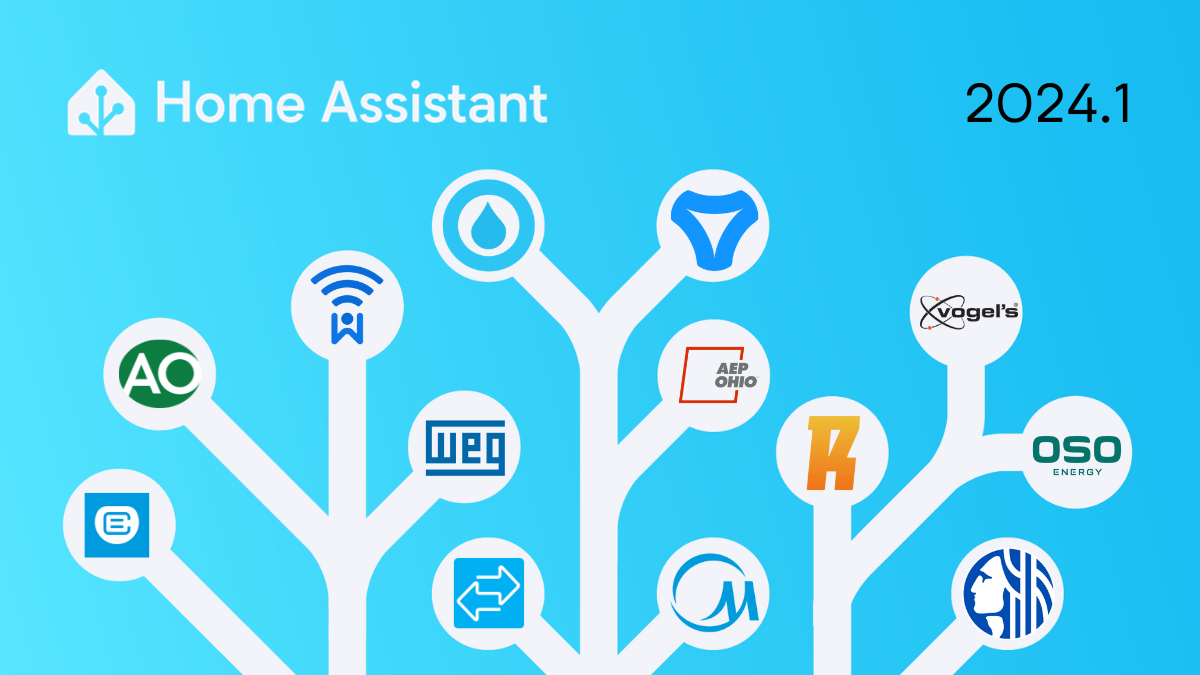
Home Assistant, the popular home automation platform, has released its first update of the year - Home Assistant Core 2024.1. While it is a relatively small release, it still brings some exciting improvements and features for users to enjoy.

One of the standout changes is the improvements made to the automation editor. The user interface has undergone several tweaks to make it more user-friendly and intuitive. New users will especially benefit from these changes, as they make it easier to understand and navigate the automation creation process. The editor now includes an improved empty automations dashboard, providing a more informative and helpful starting point for new users. Additionally, there are new building blocks that can be added to automations, such as logical elements like “And,” “Or,” and “If-then.” The trigger, condition, and action buttons have also been revamped to provide a more streamlined experience.

In addition to the automation editor improvements, Home Assistant Core 2024.1 also introduces support for descriptions and due dates in the to-do list integration. Users can now add descriptions to each task on their to-do list, and even set due dates using Markdown markup.

Another notable addition in this release is the introduction of a new entity type: Valve. This entity type can be used by integrations to expose valves, such as those found on radiators, pools, sprinkler systems, and gas or water lines in a house. The Shelly integration already supports this new entity type, and it is also compatible with MQTT, Amazon Alexa, and Google Assistant.

The thermostat and humidifier cards have also received some attention in this release. Users now have the option to set the current temperature or humidity as the primary information displayed on the card, providing more flexibility and customization.

Other changes in Home Assistant Core 2024.1 include new card features like climate fan mode and update actions, improvements to existing integrations, and the addition of several new integrations. The release also includes backward-incompatible changes for certain integrations, so users are advised to review the full changelog for more details.
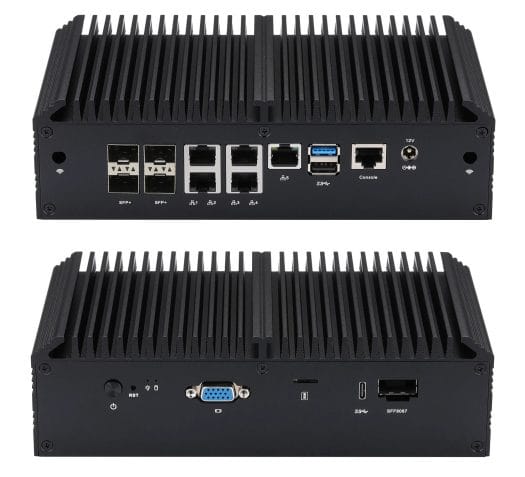
Qotom Q20332G9-S10: Fanless Mini PC with 4 10GbE and 5 2.5GbE Ports

Qotom Q20332G9-S10: Fanless Mini PC with 4 10GbE and 5 2.5GbE Ports

The Qotom Q20332G9-S10 is a fanless mini PC that can be sued as a router, due to the fact that it features four 10GbE SFP+ cages and five 2.5GbE RJ45 ports, making it a suitable network appliance. The system is powered by an Atom C3758R Denverton Refresh eight-core processor.

In terms of specifications, the Qotom Q20332G9-S10 supports up to 64GB DDR4 memory and has two M.2 NVMe SSD sockets, as well as two 2.5-inch SATA bays for storage. It also includes one extra M.2 socket for cellular connectivity and several USB ports. The system is equipped with a VGA port for video output.

The Qotom Q20332G9-S10 comes with a 12V/5A power supply and a VESA mount. It can be purchased as a barebone system or with pre-installed RAM and SSD. It is available for around $300 on Amazon and Aliexpress in its barebone configuration, with variants offering up to 64GB RAM and 2TB SSD.

Source: CNX Software – Embedded Systems News.

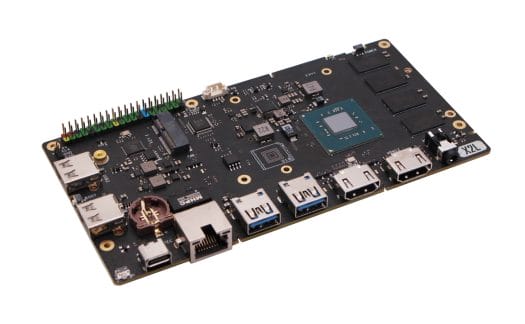
Radxa X2L: Affordable Celeron J4125 SBC

Radxa X2L: Affordable Celeron J4125 SBC

Radxa has released the X2L, an affordable single-board computer (SBC) powered by the Celeron J4125 Gemini Lake Refresh processor. The X2L comes with 2GB to 8GB of RAM, an M.2 socket for SSD storage, and another M.2 socket for a wireless module. It also offers a variety of ports, including dual HDMI, gigabit Ethernet, four USB ports, and a 40-pin GPIO header.

Specifications of the Radxa X2L include:

  • Celeron J4125 quad-core Gemini Lake Refresh processor
  • Raspberry Pi RP2040 microcontroller for GPIO control
  • 2GB, 4GB, or 8GB LPDDR4 RAM
  • 1x M.2 M-Key socket for NVMe SSD storage
  • Optional 32GB eMMC flash
  • 2x HDMI ports
  • 3.5mm headphone jack with microphone input
  • Gigabit Ethernet port
  • Optional WiFi and Bluetooth module
  • 2x USB 3.0 Type-A ports, 2x USB 2.0 Type-A ports
  • 40-pin GPIO header
  • M.2 M-Key socket for NVMe SSD
  • M.2 E-Key socket for wireless module
  • RTC battery socket
  • 4-pin header for PWM fan
  • 3-pin debug header
  • Power button, BOOTSEL button, clear CMOS button, and user button
  • 12V/2A power supply via USB-C port
  • Dimensions of 155 x 80 x 10 mm
  • Temperature range of 0 to 50°C
  • Certifications include FCC and CE

The Radxa X2L is available for purchase starting at $39 on Arace and AllNetChina. This price is for the model with 2GB of RAM. Users will need to add an M.2 SSD and a USB PD power supply. The 8GB model with a 32GB eMMC flash is also available for $79.

Source: CNX Software – Embedded Systems News.

Firefly EXT-2.5GE-RK3588-RT: Quad 2.5GbE Ethernet Expansion Board for ROC-RK3588-RT SBC

Firefly EXT-2.5GE-RK3588-RT: Quad 2.5GbE Ethernet Expansion Board for ROC-RK3588-RT SBC

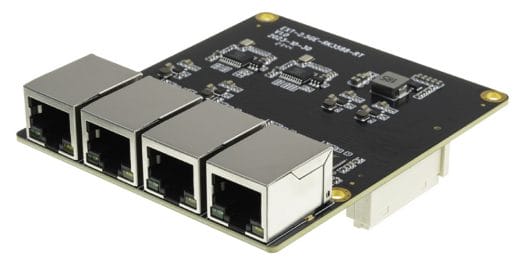
Firefly has launched the EXT-2.5GE-RK3588-RT, a 2.5GbE Ethernet Expansion Board for the ROC-RK3588-RT Rockchip RK3588 SBC. The ROC-RK3588-RT SBC already features three Ethernet ports, making it ideal for routers and firewalls. The EXT-2.5GE-RK3588-RT adds four more 2.5GbE ports to the SBC, bringing the total number of Ethernet ports to seven with five 2.5GbE and two GbE RJ45 jacks. The board uses the RTL8125BG IC for Ethernet control and the PI6C557-05 IC as a spectrum clock generator.

Source: CNX Software – Embedded Systems News.

Tillitis Tkey: An Open-Source USB-C RISC-V Security Key

Tillitis Tkey: An Open-Source USB-C RISC-V Security Key

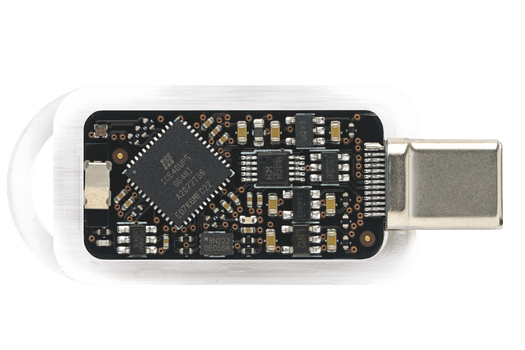
The Tillitis TKey is a unique USB-C security key based on a 32-bit RISC-V core, specifically the PicoRV32, housed in a Lattice iCE40 UP5K FPGA. Described as a “new type of flexible USB security token,” it draws inspiration from DICE (Device Identifier Composition Engine) and measured boot technologies. Unlike traditional security keys with persistent onboard storage, the TKey relies on loading apps onto the key each time it connects to a host device. This method, employing measured boot, generates a distinct identifier for each application, enhancing security by avoiding the storage of private keys on the device. Both the hardware and software for the TKey are entirely open-source, ensuring trustability. Developed by Tillitis, a Swedish security firm, the TKey has two versions: locked and unlocked. The locked version, targeting general users, is not reprogrammable, while the unlocked version allows full configuration using the Tillitis TK Programmer, based on a Raspberry Pi Pico, for added flexibility. Tillitis specializes in hardware trust products and emerged as a separate entity from the Mullvad VPN company in 2022.

Specifications:

  • Processor:
    • 32-bit RISC-V PicoRV32 core @ 18 MHz
    • FPGA: Lattice iCE40 UP5K
    • 128 KiB RAM for TKey device application
    • 2 KiB RAM for firmware
    • 6 KiB ROM
    • Execution monitor
    • RAM protection
  • Connector: USB-C
  • Hardware Privilege Modes: Firmware mode and application mode
  • Misc: Touch sensor, power indicator, status indicator
  • Input voltage: 5V
  • Max current consumption: 100mA
  • Operating temperature: 0°C – 40°C

The Tillitis TKey RISC-V security key can be purchased from the Tillitis shop. The end-user version and the advanced user version are priced at 880 Swedish kronor (about $90), while the programmer is priced at 500 Swedish kronor (around $50).

Source: CNX Software – Embedded Systems News.

Terramaster Introduces Alder Lake-N Chips to NAS Systems

Terramaster Introduces Alder Lake-N Chips to NAS Systems

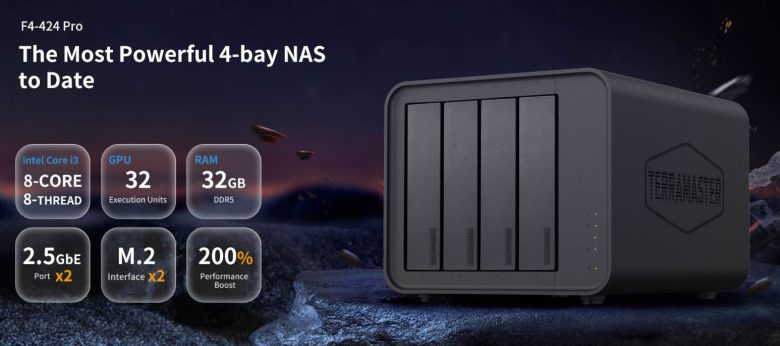
Terramaster, a NAS maker, has introduced three new models featuring Alder Lake-N processors. The Terramaster F2-424 and F4-424 are 2-bay and 4-bay network attached storage systems respectively, while the Terramaster F4-424 Pro is touted as the “most powerful 4-bay NAS in the industry to date.” These NAS systems offer significant performance improvements over previous models, with the Alder Lake-N processors delivering around 25% faster CPU performance and even higher graphics performance compared to older chips. The F2-424 and F4-424 come with 8GB of DDR5 memory, while the F4-424 Pro includes 32GB of RAM.

The specifications for the Terramaster NAS systems are as follows:

  • Terramaster F2-424 and F4-424:
    • Processor: 15-watt N95 CPU with 4 cores, 4 threads, CPU speeds up to 3.4 GHz, and 1.2 GHz UHD integrated graphics
    • Memory: 8GB DDR5 (supports up to 32GB)
  • Terramaster F4-424 Pro:
    • Processor: 7-watt Core i3-N300 CPU with 8 cores, 8 threads, speeds up to 3.8 GHz, and a 1.25 GHz UHD GPU with 32 execution units
    • Memory: 32GB RAM

Prices for the Terramaster NAS systems start at $380 for the 2-bay F2-424 and $500 for the 4-bay F4-424. The high-performance F4-424 Pro is priced at $700. However, it’s important to note that the price does not include hard drives for storage.

In addition to the powerful processors, the new Terramaster NAS systems also offer other notable features. They come with two M.2 2280 slots for PCIe NVMe storage, allowing users to use SSDs for cache or primary storage. The networking features include two 2.5 Gbe Ethernet ports, an HDMI 2.1 port, and two USB 3.2 Gen 2 ports.

While these Terramaster NAS systems offer impressive performance, there are some factors to consider. The Asustor AS5402T, for example, has two SODIMM slots for memory, making it more cost-effective and easier to add memory compared to the Terramaster models. The AS5402T also has four M.2 slots for PCIe NVMe storage, providing more storage expansion options. Other options to consider include Synology and QNAP models.

Source: Liliputing.