Posts for: #release

January Update for openSUSE Tumbleweed

In the latest monthly update for openSUSE Tumbleweed in January 2024, the distribution unveils a new format to better communicate major changes, improvements, and key issues. This update is now recommended by contributors involved in openSUSE’s marketing efforts.

Kernel and Hardware Support

The Linux Kernel receives updates to versions 6.6.7, 6.6.9, 6.6.10, 6.6.11, and 6.7.1, addressing memory management and security vulnerabilities. Notable enhancements include PCI updates for Zhaoxin Root Ports, contributing to improved compatibility and performance for Zhaoxin’s CPUs and motherboards.

Browser and Graphics Updates

Mozilla Firefox is updated to version 121.0 and 121.0.1, resolving issues such as hanging when loading sites with column-based layouts. The KDE Frameworks update to version 5.114.0 brings significant improvements, including fixes in Extra CMake Modules, holiday additions for Kenya, and adjustments for AVIF in KImageFormats.

The Mesa update to version 23.3.3 introduces a new Vulkan driver for NVIDIA hardware (NVK) in the experimental phase. This marks a step forward in support for NVIDIA GPUs, accompanied by enhancements in graphics performance and compatibility for Asahi and RADV.

System Management and PHP Enhancements

Systemd sees updates to version 254.8, focusing on the cautious resolution of reported bugs and ensuring stability in device management systems. PHP is updated from version 8.2.14 to 8.2.15, bringing fixes for SSA integrity verification, improvements in CLI built-in web server timeouts, and resolving issues with stream wrapper registration.

Multimedia and Networking

GStreamer is updated to version 1.22.8, addressing vulnerabilities in the AV1 video codec parser and making improvements in reverse playback and seeking in qtdemux. Samba sees updates to version 4.19.4, resolving issues related to the machine account password, improving documentation generation, and addressing critical vulnerabilities and bugs.

Security and Bug Fixes

The update includes critical security patches across various packages, with notable improvements in Firefox, systemd, Samba, and PHP. Multiple Common Vulnerabilities and Exposures (CVEs) are addressed in packages like xorg-x11-server, xwayland, gnutls, java-11-openjdk, and samba, enhancing overall security and stability.
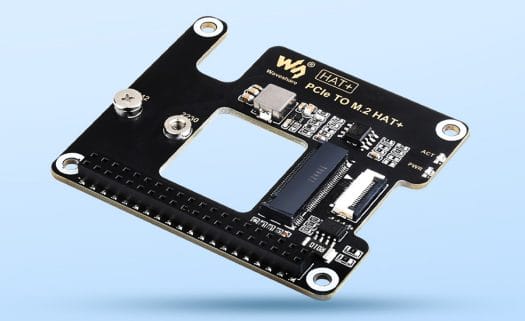
Affordable Waveshare PCIe to M.2 Adapter for Raspberry Pi 5

Affordable Waveshare PCIe to M.2 Adapter for Raspberry Pi 5

The Waveshare PCIe To M.2 adapter is an affordable PCIe to M.2 HAT+ module designed specifically for the Raspberry Pi 5.

It supports PCIe Gen2 and Gen3 SSDs and is compatible with standard SSD sizes of 2230/2242. The adapter features status indicator LEDs, a power monitoring chip, an EEPROM, and a cooling fan vent to manage temperatures during heavy use. This adapter is not the first of its kind for the Raspberry Pi 5, as other options like the PineBerry Pi’s HatDrive and the Pimoroni NVMe Base have been previously explored. The Waveshare PCIe To M.2 adapter shares a similar form factor with Waveshare’s PoE HAT(F), which uses the new HAT+ standard to provide 24W of power to the Raspberry Pi 5.

The adapter’s specifications include compatibility with Raspberry Pi 5 SBC, M.2 SSD interface compatibility, a compact form factor, status indicator LEDs, an EEPROM, and a power monitoring chip.

The package includes the PCIe To M.2 HAT, a double-row 20-pin header, a 16-pin cable, and a set of standoffs for mounting. The product dimensions are 65.00 x 56.50 mm.

The Waveshare PCIe To M.2 adapter is available for purchase for $8.99 on the company’s online store, and it’s also availble on other online stores.

Source: CNX Software – Embedded Systems News.

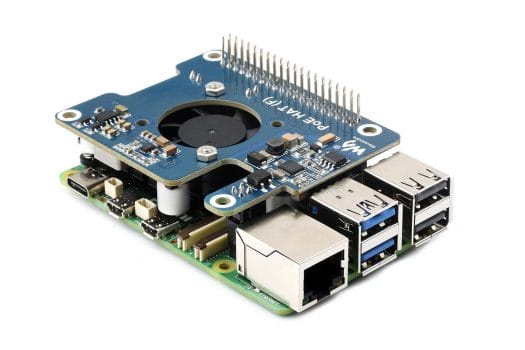
Waveshare Releases PoE HAT+ Kit, the PoE HAT(F)

Waveshare Releases PoE HAT+ Kit, the PoE HAT(F)

Waveshare has released the PoE HAT(F), an 802.3af/at-compliant 24W Power-over-Ethernet (PoE) board designed for the Raspberry Pi 5. This HAT also includes a cooling solution for the SBC, featuring an embedded fan, a heatsink, and two thermal pads.

The Waveshare PoE HAT(F) features the following specifications:

  • Connection: 40-pin Raspberry Pi GPIO header and 4-pin PoE header
  • PoE (Power Over Ethernet):
    • IEEE 802.3af/at compliant
    • Input voltage: 37V-57V DC input
    • Output:
      • 2-pin header: 12V/2A max
      • GPIO header: 5V/4.5A max
  • Fully isolated switched-mode power supply (SMPS)
  • MP8759GD buck converter chip
  • Cooling: Fan, metal heatsink, and thermal pads for heat dissipation
  • Dimensions: 70 x 56.5 mm

The Waveshare PoE Hat(F) is currently available for purchase on Amazon, AliExpress, and on Waveshare’s online store.

Source: CNX Software – Embedded Systems News.

Netmaker Releases Version 0.22.0 of WireGuard Mesh VPN

Netmaker Releases Version 0.22.0 of WireGuard Mesh VPN

Netmaker has announced the release of version v0.22.0 of its WireGuard mesh VPN software. One of the key features of Netmaker is its ability to automate virtual networks between data centers, clouds, and edge devices. This eliminates the need for manual configuration and allows for easy scalability.

The latest version introduces several new features and improvements. Some of the highlights include:

  • Revamped Internet Gateways
  • MQ fallback
  • Deprecating TURN in favor of failover hosts on Pro
  • Switch to CoreDNS for DNS resolution
  • DNS is no longer managed with the OS hosts file (/etc/hosts file)
  • Added support for RAC on mobile

In addition to the new features, version v0.22.0 also addresses several bugs and issues found in previous versions. Some of the fixes include:

  • Expired nodes not getting deleted
  • nmctl acl subcommand leading to a dirty state
  • Enforce private network ranges
  • Minor bugs and enhancements with user management
  • Scalability issues

SQLite 3.45 Updates JSON Functions for JSONB Usage

SQLite 3.45 has been released, and it brings several improvements to the popular SQL database library. One major enhancement is the optimization of the SQLITE_DIRECT_OVERFLOW_READ feature, which is now enabled by default. This optimization can significantly improve the read performance for applications that heavily rely on SQLite and read large BLOBs or strings. Another, perhaps more exciting update in SQLite 3.45 is the rewriting of all JSON functions to utilize the JSONB format. The JSONB version of SQLite’s JSON functions offers several times better performance compared to the existing JSON support within SQLite.

JSONB is a new internal-use binary representation of JSON that is stored as an SQL BLOB. This format allows SQLite’s internal binary representation of JSON to be directly stored in the database, eliminating the overhead of parsing and rendering JSON when reading and updating JSON values. Furthermore, the JSONB format takes up slightly less disk space than text JSON.

Source: Phoronix.

Libvirt 10.0 Enhances QEMU VM Migration

Libvirt, a virtualization API managing virtualization on Linux, has released version 10.0. This update brings several new features, particularly in its QEMU support.

One notable addition in libvirt 10.0 is the postcopy-preempt migration capability. This feature allows for faster migration of memory pages by ensuring that the destination reads them before they are migrated from the source. Regarding QEMU, libvirt 10.0 introduces support for mapping I/O threads to virtqueues of virtio-blk devices. It also provides automatic resizing of block-device-backed disks to match the full size of the device. Additionally, libvirt 10.0 includes automatic selection and binding of VFIO variant drivers, as well as a runtime configuration option for nbdkit.

Other improvements in libvirt 10.0 include enhancements to the migration XML usage when persisting VM on the destination. It also simplifies non-shared storage migration to raw block devices, supports hotplug/unplug of PCI devices within the test driver, and includes various bug fixes.

Source: Phoronix.