Posts for: #release

UGREEN Unveils 12th-Gen Processors, M.2 SSD Support, and DDR5 Memory in NAS Devices

UGREEN Unveils 12th-Gen Processors, M.2 SSD Support, and DDR5 Memory in NAS Devices

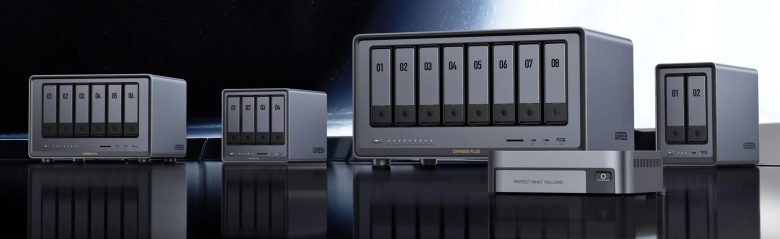
UGREEN is expanding into the network attached storage (NAS) hardware market. The company is showcasing its first models in the UGREEN NASync lineup at CES 2024 and plans to launch them soon through a crowdfunding campaign.

The entry-level NASync DXP2800 features an N100 Alder Lake-N processor, 32GB of eMMC onboard storage, two SATA drive bays for 3.5-inch hard drives or SSDs, two M.2 slots for PCIe NVMe SSDs, 8GB of upgradeable DDR5 memory (expandable to 16GB), a 2.5 GbE Ethernet port, a USB 3.2 Gen 2 Type-C port, a USB 3.2 Gen 2 Type-A port, a USB 3.2 Gen 1 Type-A port, two USB 2.0 Type-A ports, and an HDMI port with 4K display support.

The NASync DXP4800 is similar to the DXP2800 but offers four SATA drive bays, two 2.5 GbE Ethernet ports, and an SD card reader.

UGREEN’s NASync DXP4800 Pro is an upgraded version with an Pentium Gold 8505 processor, a 128GB SSD for storage, support for up to 32GB of RAM, one 10 GbE connector, and one 2.5 GbE Ethernet port.

The NASync DXP6800 and DXP880 Plus models support 6 and 8 hard drives, respectively. They are powered by Core i5-1235U processors, feature 128GB SSDs, support up to 32GB of RAM, and have dual 10 GbE network ports. These models also include two Thunderbolt 4 ports, two USB 3.2 Gen 2 Type-A ports, two USB 2.0 ports, HDMI ports capable of driving displays up to 8K, and PCIe x4 expansion slots.

The final model, the UGREEN NASync DXP480T Plus, is a compact all-flash storage system without any hard drive bays. It features four M.2 slots for solid-state storage, an Core i5-1235U processor, a 128GB SSD, support for up to 32GB of RAM, a 10 GbE network port, two Thunderbolt 4 ports, an 8K-ready HDMI connector, and a USB 3.2 Gen 2 Type-A port. It is also the only model in the lineup with integrated WiFi.

For more information, refer to the press release.

Source: Liliputing.

OpenTofu: General Availability Release

OpenTofu: General Availability Release

OpenTofu, the open source fork of Terraform, has reached a significant milestone with the announcement of its general availability. The project, now under the Linux Foundation, is ready for production use after four months of development by over five dozen developers. OpenTofu offers a straightforward migration path for Terraform users and showcases the value of open source.

The release of OpenTofu 1.6 introduces several important features, including advanced testing capabilities for improved stability, an enhanced S3 state backend with new authentication methods, and a new provider and module registry. Additionally, the release includes hundreds of performance enhancements, bug fixes, and other improvements.

OpenTofu has gained significant traction in the community, with dozens of developers contributing, hundreds of active community members, thousands of GitHub followers, and support from corporate backers and technology partners such as CloudFlare, BuildKite, GitLab, and Oracle.

Looking ahead, OpenTofu 1.7 is set to introduce even more community-requested features that are not available in Terraform. These features include client-side state encryption for heightened security in regulated environments, parameterizable backends, providers, and modules for more readable code, and third-party extensibility through a plugin system for new state backends.

The general availability of OpenTofu marks a important achievement for the project and the open source community.

Source: Linux Foundation.

ASRock Industrial Releases Motherboards for 14th Gen Raptor Lake-S Refresh CPUs

ASRock Industrial Releases Motherboards for 14th Gen Raptor Lake-S Refresh CPUs

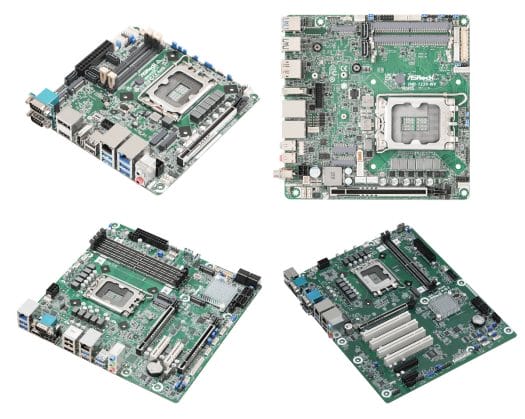
ASRock Industrial has announced 25 industrial motherboards powered by 14th gen Raptor Lake-S Refresh processors with up to 24 cores and 32 threads.

These motherboards support up to 96GB DDR5 memory and are available in mini-ITX, micro-ATX, and ATX form factors. They offer features such as support for up to four 4K displays, PCIe Gen5 interfaces, multiple Ethernet ports, and USB 3.2 Gen2x2 ports. The motherboards are designed for applications in factory automation, robotics, machine vision, smart retail, kiosks, digital signage, gaming, and security. ASRock Industrial has updated the BIOS of its existing motherboards to support the new 14th gen processors. The industrial motherboards are split into main families with either DDR5 or DDR4 memory, and various chipset options are available.

Even though these motherboards are designed for industrial tasks, they could potentially find use in a home lab setting, as well.

Source: CNX Software – Embedded Systems News.

Pi-hole FTL and Core Receive Latest Updates

Pi-hole FTL and Core Receive Latest Updates

Pi-hole has released updates to its FTL (v5.24) and Core (v5.17.3) components. These updates bring several changes and improvements to enhance the performance and functionality of Pi-hole.

While the development team is primarily focused on the upcoming v6.0 beta, they remain committed to supporting and enhancing v5. They understand that many users still rely on v5 and want to ensure that it remains robust and up-to-date. Consequently, certain improvements and changes developed for v6.0 will be backported to v5, providing the best experience for all users, whether they are part of the public beta or not.

The FTL changes in this release include updating the dependabot.yml file, adding pihole-FTL sqlite3 -ni, fixing a possible crash with high client activity, and implementing special domains whitelisting. These changes aim to improve the stability and performance of Pi-hole FTL.

On the other hand, the Core changes include adding “-ni” to all sqlite3 invocations in v5. This modification ensures the proper functioning of sqlite3 in Pi-hole Core.

Users are advised to read the detailed changelogs before updating to these latest versions. The FTL changelog can be found here, and the Core changelog can be accessed here.

Source: Pi-Hole.

Home Assistant Unveils 2024.1: The Initial Release of the Year

Home Assistant Unveils 2024.1: The Initial Release of the Year

Home Assistant, the popular home automation platform, has released its first update of the year - Home Assistant Core 2024.1. While it is a relatively small release, it still brings some exciting improvements and features for users to enjoy.

One of the standout changes is the improvements made to the automation editor. The user interface has undergone several tweaks to make it more user-friendly and intuitive. New users will especially benefit from these changes, as they make it easier to understand and navigate the automation creation process. The editor now includes an improved empty automations dashboard, providing a more informative and helpful starting point for new users. Additionally, there are new building blocks that can be added to automations, such as logical elements like “And,” “Or,” and “If-then.” The trigger, condition, and action buttons have also been revamped to provide a more streamlined experience.

In addition to the automation editor improvements, Home Assistant Core 2024.1 also introduces support for descriptions and due dates in the to-do list integration. Users can now add descriptions to each task on their to-do list, and even set due dates using Markdown markup.

Another notable addition in this release is the introduction of a new entity type: Valve. This entity type can be used by integrations to expose valves, such as those found on radiators, pools, sprinkler systems, and gas or water lines in a house. The Shelly integration already supports this new entity type, and it is also compatible with MQTT, Amazon Alexa, and Google Assistant.

The thermostat and humidifier cards have also received some attention in this release. Users now have the option to set the current temperature or humidity as the primary information displayed on the card, providing more flexibility and customization.

Other changes in Home Assistant Core 2024.1 include new card features like climate fan mode and update actions, improvements to existing integrations, and the addition of several new integrations. The release also includes backward-incompatible changes for certain integrations, so users are advised to review the full changelog for more details.

Qotom Q20332G9-S10: Fanless Mini PC with 4 10GbE and 5 2.5GbE Ports

Qotom Q20332G9-S10: Fanless Mini PC with 4 10GbE and 5 2.5GbE Ports

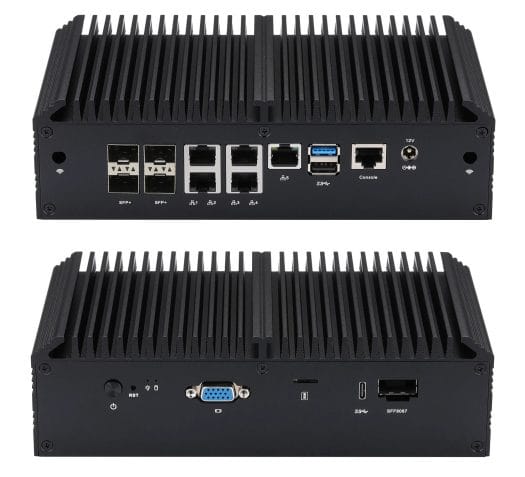
The Qotom Q20332G9-S10 is a fanless mini PC that can be sued as a router, due to the fact that it features four 10GbE SFP+ cages and five 2.5GbE RJ45 ports, making it a suitable network appliance. The system is powered by an Atom C3758R Denverton Refresh eight-core processor.

In terms of specifications, the Qotom Q20332G9-S10 supports up to 64GB DDR4 memory and has two M.2 NVMe SSD sockets, as well as two 2.5-inch SATA bays for storage. It also includes one extra M.2 socket for cellular connectivity and several USB ports. The system is equipped with a VGA port for video output.

The Qotom Q20332G9-S10 comes with a 12V/5A power supply and a VESA mount. It can be purchased as a barebone system or with pre-installed RAM and SSD. It is available for around $300 on Amazon and Aliexpress in its barebone configuration, with variants offering up to 64GB RAM and 2TB SSD.

Source: CNX Software – Embedded Systems News.