Posts for: #risc-v

Tillitis Tkey: An Open-Source USB-C RISC-V Security Key

Tillitis Tkey: An Open-Source USB-C RISC-V Security Key

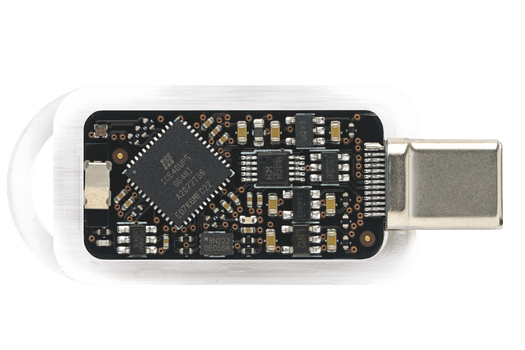
The Tillitis TKey is a unique USB-C security key based on a 32-bit RISC-V core, specifically the PicoRV32, housed in a Lattice iCE40 UP5K FPGA. Described as a “new type of flexible USB security token,” it draws inspiration from DICE (Device Identifier Composition Engine) and measured boot technologies. Unlike traditional security keys with persistent onboard storage, the TKey relies on loading apps onto the key each time it connects to a host device. This method, employing measured boot, generates a distinct identifier for each application, enhancing security by avoiding the storage of private keys on the device. Both the hardware and software for the TKey are entirely open-source, ensuring trustability. Developed by Tillitis, a Swedish security firm, the TKey has two versions: locked and unlocked. The locked version, targeting general users, is not reprogrammable, while the unlocked version allows full configuration using the Tillitis TK Programmer, based on a Raspberry Pi Pico, for added flexibility. Tillitis specializes in hardware trust products and emerged as a separate entity from the Mullvad VPN company in 2022.

Specifications:

  • Processor:
    • 32-bit RISC-V PicoRV32 core @ 18 MHz
    • FPGA: Lattice iCE40 UP5K
    • 128 KiB RAM for TKey device application
    • 2 KiB RAM for firmware
    • 6 KiB ROM
    • Execution monitor
    • RAM protection
  • Connector: USB-C
  • Hardware Privilege Modes: Firmware mode and application mode
  • Misc: Touch sensor, power indicator, status indicator
  • Input voltage: 5V
  • Max current consumption: 100mA
  • Operating temperature: 0°C – 40°C

The Tillitis TKey RISC-V security key can be purchased from the Tillitis shop. The end-user version and the advanced user version are priced at 880 Swedish kronor (about $90), while the programmer is priced at 500 Swedish kronor (around $50).

Source: CNX Software – Embedded Systems News.
Sophgo SG2380 RISC-V SoC Expands RAM Support to 96GB, Adds PCIe and 25 GbE

Sophgo SG2380 RISC-V SoC Expands RAM Support to 96GB, Adds PCIe and 25 GbE

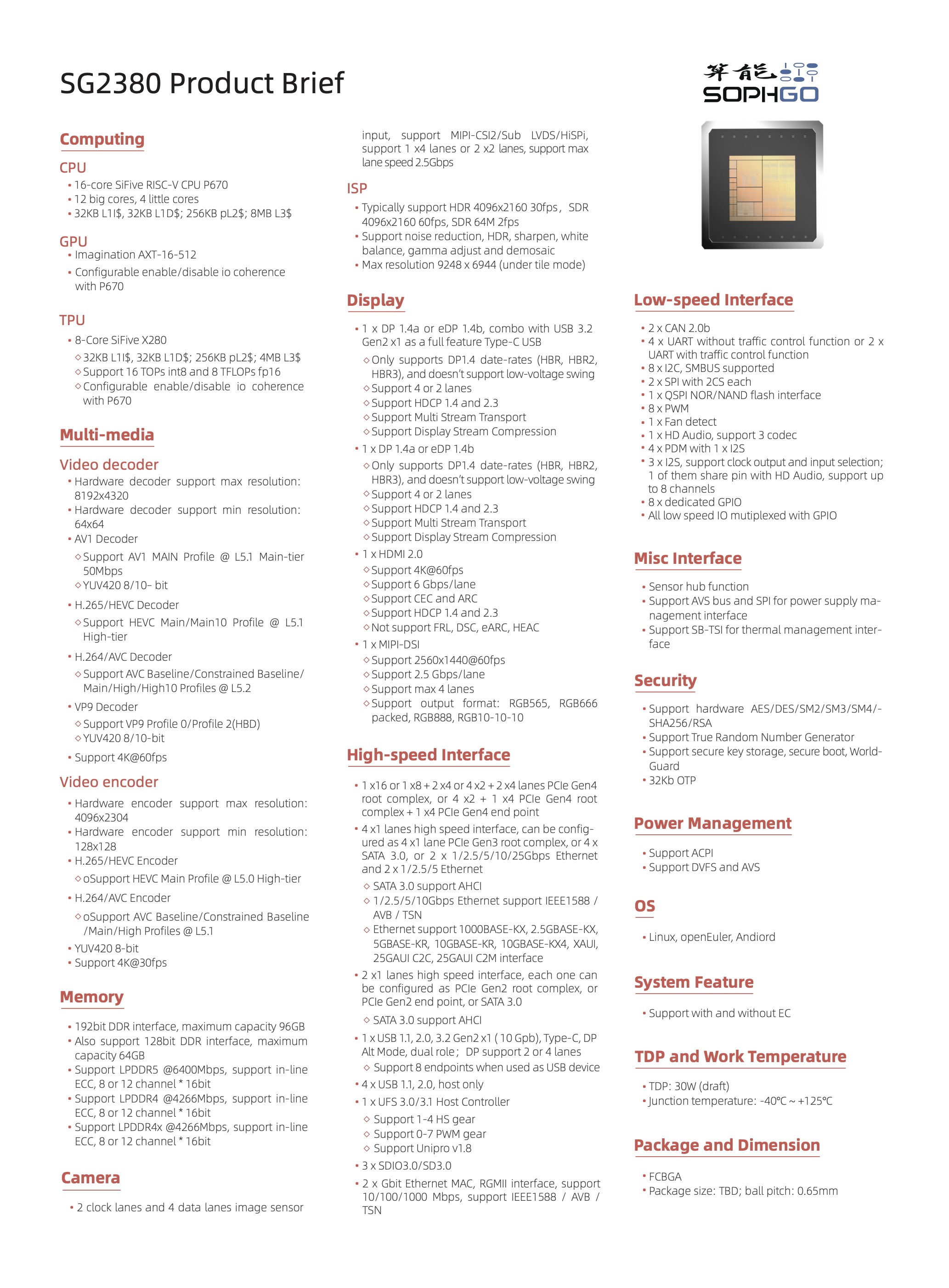
The Sophgo SG2380 RISC-V SoC has received an upgrade, according to a recent announcement by Milk-V. The SoC, which was previously announced in October, now supports up to 96GB of RAM, an increase from the previous limit of 64GB. The memory is now using a 192-bit interface. Additionally, the SG2380 has been upgraded with an additional PCIe x16 lanes and now supports up to 25 Gbps Ethernet. Milk-V has shared the upgraded specifications of the Sophgo SG2380 SoC on their website.

Overall, the upgraded capabilities of the Sophgo SG2380 RISC-V SoC are promising, and it will be interesting to see how it performs when it becomes available in the future.

Source: Phoronix.

AMDGPU DC Display Code Update Enables Newer AMD GPUs on RISC-V

SiFive has addressed compatibility issues between AMD’s Linux graphics drivers and newer GPUs on RISC-V architecture. The problem, linked to AMDGPU’s “DC” display code, was resolved by introducing kernel-mode FPU support for RISC-V. SiFive’s patches, currently under review, are expected to be part of the Linux 6.8 kernel. Once implemented, this update will allow the latest AMD GPUs to seamlessly operate on RISC-V using open-source drivers.

Source: Phoronix.

BeagleV-Fire SBC: Affordable $150 Board with Microchip PolarFire RISC-V SoC FPGA and BeagleBone Cape Support

BeagleV-Fire is a new single board computer powered by Microchip PolarFire MPFS025T penta-core RISC-V SoC FPGA. It follows the BeagleBone Black form factor for compatibility with BeagleBone capes expansion boards. The BeagleV-Fire features a Microchip PolarFire MPFS250T FCVG484E SoC FPGA with a penta-core RISC-V CPU, 2GB LPDDR4 system memory, and various storage options including 16GB eMMC and a MicroSD card socket. It also includes a MIPI CSI camera connector, Gigabit Ethernet port, USB 2.0 Type-C port, and multiple expansion options such as M.2 E-Key socket and BeagleBone Cape add-on headers. The board supports Ubuntu and comes with preinstalled Linux for easy setup. The BeagleV-Fire is available for $149 and can be purchased from various distributors. More information can be found on the official product page.

Source: CNX Software – Embedded Systems News.

Alibaba Releases User Manuals for T-Head TH1520 RISC-V CPU

Alibaba has released nine user manuals for the T-Head TH1520 quad-core RISC-V processor. These manuals cover various aspects of the processor, including video and audio processing, peripheral interfaces, memory interfaces, system registers, and the built-in NPU for video acceleration.

The TH1520 RISC-V SoC was first mentioned in the expensive web3-focused ROMA laptop in October 2022. Since then, there have been interesting developments with the release of Sipeed’s Lichee Pi 4A SBC and various other platforms based on the LM4A system-on-module. Both boards have preliminary support in mainline Linux, with the Lichee Pi 4A making it to Linux 6.5 and the BeagleV Ahead being added to the Linux 6.6 kernel.

The user manuals for the TH1520 processor were not released publicly until now. Sipeed and Beagleboard.org have made available nine user manuals in English, with the Sipeed link also providing the Chinese versions.

While these user manuals are useful for people writing drivers for the TH1520 SoC, some of the documents may not provide enough details to be truly useful, especially those related to the video blocks of the TH1520 processors. Nonetheless, having public documentation is a step in the right direction.

Source: CNX Software – Embedded Systems News.

Highlights of Linux 6.6 Release: Arm, RISC-V, and MIPS Architectures

The Linux 6.6 release has just been announced by Linus Torvalds on the Linux Kernel Mailing List. This release comes about two months after the release of Linux 6.5, and it brings several notable changes and updates to the kernel.

One of the highlights of Linux 6.6 is the addition of Intel’s shadow stack hardware support. This feature helps prevent exploits by maintaining a secondary (shadow) stack that cannot be directly modified. The processor pushes the return address to both the normal stack and the shadow stack, and upon return, it compares the two copies. If they differ, the processor raises a control protection fault, which can prevent stack modification exploits. It’s important to note that this implementation only supports shadow stack on 64-bit kernels and offers support for 32-bit via IA32 emulation only for userspace.

Another significant change in Linux 6.6 is the introduction of the EEVDF task scheduler. This scheduler replaces the CFS (Completely Fair Scheduler) that was merged in Linux 2.6.23. The EEVDF scheduler is designed to ensure that processes that are not getting the attention they deserve are automatically picked the next time, while processes that have been given more attention than necessary are “punished.” This algorithmic approach improves the latency of tasks that would be left behind by the CFS scheduler.

Additionally, Linux 6.6 brings faster asynchronous Direct I/O using io_uring, resulting in up to a 37% improvement in throughput/latency for low queue depth IO.

In terms of Arm architecture changes, Linux 6.6 introduces various updates and additions for Allwinner, Rockchip, Amlogic, Samsung, Qualcomm, MediaTek, and other Arm platforms. These changes include support for new boards, improvements to clock drivers, additions to device trees, and various driver updates.

The RISC-V architecture also sees some updates in Linux 6.6, including support for new device tree interfaces, userspace access to performance counters, more instructions in kprobes, crash kernels allocated above 4GiB, support for KCFI, and more. The MIPS architecture receives some cleanups and fixes in this release.

Overall, the Linux 6.6 release brings important updates and improvements to the kernel, enhancing security, task scheduling, and I/O performance. It also expands support for various architectures, including Arm, RISC-V, and MIPS. Linux enthusiasts and developers will find these updates valuable for their servers, Linux-based home labs, and DevOps environments.

Source: CNX Software – Embedded Systems News.