Posts for: #rockchip-rk35xx

Embedfire LubanCat 4 Card Computer: Rockchip RK3588S Dev Board with Mini PCIe Socket

Embedfire LubanCat 4 Card Computer: Rockchip RK3588S Dev Board with Mini PCIe Socket

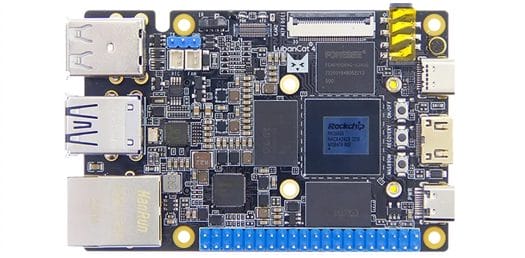
EmbedFire LubanCat 4 card computer, also known as LubanCat 4, is a feature-packed Rockchip RK3588S Single Board Computer (SBC) launched by Yehuo Electronic. This compact board measuring 85x56mm offers a wide range of functionalities, including Ethernet, USB, mini PCIe, HDMI 2.1, SIM card slot, microSD card holder, and more.

EmbedFire LubanCat 4 Specifications:

  • SoC: Rockchip RK3588S
    • CPU: Octa-core processor with 4x Cortex-A76 cores up to 2.2-2.4 GHz and 4x Cortex-A55 cores up to 1.8 GHz
    • GPU: Arm Mali-G610 GPU with support for OpenGL ES 3.2, OpenCL 2.2, and Vulkan 1.2
    • VPU: 8Kp60 video decoder and 8Kp30 video encoder
    • AI Accelerator: 6 TOPS NPU
  • System Memory: 4/8/16GB LPDDR4X
  • Storage: Options include no eMMC/32/64/128GB, microSD card socket
  • Video Output: Mini HDMI 2.1, 2x MIPI DSI connectors, USB Type-C interface supporting DP protocol
  • Networking: Gigabit Ethernet RJ45 port, optional WiFi or cellular mini PCIe module
  • USB Ports: 3x USB 2.0 Type-A interfaces, 1x USB 3.0 Type-A interface, 1x USB 3.0 Type-C interface
  • Expansion: Mini PCIe interface, 40-pin Raspberry Pi-compatible GPIO header
  • Misc: RTC battery connection socket, 5V fan header for cooling
  • Power Supply: 5V/4A DC input via USB Type-C
  • Dimensions: 85 x 56 mm

The board supports various operating systems including Android 13, Debian, Ubuntu, and ROS, all available on their GitHub repository. However, there is limited documentation available for the board at the moment.

The EmbedFire LubanCat 4 SBC is available for purchase on AliExpress with prices starting at around $110 for the 4GB RAM version without eMMC. This board offers a Raspberry Pi-sized solution powered by the robust Rockchip RK3588S SoC, making it a compelling choice for developers and enthusiasts looking to explore various projects in the server, Linux, DevOps, and home lab environments.

Source: CNX Software – Embedded Systems News.

Radxa ROCK 3B: Fusion of Pico-ITX and Raspberry Pi Form Factors

Radxa has released the ROCK 3B, a “PI-CO ITX” single-board computer (SBC) that combines the benefits of Pico-ITX and Raspberry Pi form factors. The board, measuring 100x72mm, features all main ports on the rear side and supports expansion through a 40-pin Raspberry Pi-compatible GPIO header and several M.2 sockets for storage and wireless modules. The ROCK 3B is the larger brother of the ROCK 3A, a business card-sized SBC introduced in 2021. Both boards are powered by the Rockchip RK3568 SoC and support up to 8GB LPDDR4. The ROCK 3B features two gigabit Ethernet ports, an M.2 B Key socket for 4G LTE/5G cellular modules, an M.2 PCIe 3.0 x1 socket for an M.2 2280 SSD, and an M.2 Key-E socket for WiFi 6.

The specifications of the ROCK 3B include:

  • SoC: Rockchip RK3568 (J)
    • CPU: Quad-core Cortex A55 processor at up to 2.0 GHz
    • GPU: Mali G52 GPU with support for OpenGL ES 1.1/2.0/3.2, OpenCL 2.0, Vulkan 1.1
    • VPU: 4Kp60 H.264/H.265/VP9 video decoder, 1080p60 H.264/H.265 video encoder
    • AI accelerator: 1 TOPS NPU; INT8/INT16/FP16/BFP16 MAC hybrid operation; support for TensorFlow, TF-lite, Pytorch, Caffe, ONNX, MXNet, Keras, Darknet
  • System Memory: 2GB, 4GB, 8GB LPDDR4
  • Storage: Pluggable eMMC module, MicroSD card slot, M.2 M key socket for NVMe with PCIe 3.0 x2
  • Video Output: HDMI 2.0 port up to 4Kp60, 2x MIPI DSI connectors (4-lane and 2-lane), eDP connector, Touch Panel connector
  • Camera: 1x MIPI CSI connector
  • Audio: 3.5mm audio jack, digital audio via HDMI
  • Connectivity: 2x Gigabit Ethernet ports, WiFi 6 via M.2 E key socket with PCIe 2.0 x1/SDIO/UART, 4G LTE/5G cellular via M.2 B key 3042 socket with PCIe, SATA, USB interfaces, and a SIM card socket
  • USB: 2x USB 2.0 ports, 2x USB 3.0 ports (1x OTG+1x HOST)
  • Expansion: Color-coded 40-pin GPIO header mostly compatible with ROCK Pi 4 and Raspberry Pi 3/4, exposing 5x UART, 1x SPI, 2x I2C, 1x PCM/I2S, 1x CAN bus, 6x PWM, 1x ADC, 6x GPIO, 1x USB 2.0, and 5V, 3.3V, and GND power signals
  • Misc: RTC with connector for backup battery, IR receiver, RGB LED, Fan header, Power and recovery buttons
  • Power Supply: 6V to 20V DC via USB-C port with USB PD 2.0, QC 3.0, or fixed voltage support, 5V via GPIO pin 2 or 4
  • Dimensions: 100 x 75 mm (Pico-ITX and PI-CO ITX form factors)
  • Certifications: CE/FCC

The Rock 3B was first unveiled in 2021 with a slightly different design, which was modified based on user feedback. The board is now available for purchase, with prices starting at $45 for the 2GB RAM version, $55 for the 4GB RAM version, and $75 for the 8GB RAM version on Arace Tech. However, it may be challenging to find compatible accessories as the website’s accessories section is not clear, and some accessories are missing.

Source: CNX Software – Embedded Systems News.

FriendlyELEC CM3588 NAS Kit: Four NVMe PCIe Gen 3 x1 Sockets

FriendlyELEC has introduced the CM3588 NAS Kit, which features the new Rockchip RK3588 board. The board comes with four M.2 Key-M sockets, each with a PCIe Gen 3 x1 interface, designed to accommodate 2280 NVMe SSDs or other M.2 PCIe modules. The CM3588 NAS Kit is equipped with the CM3588 Core system-on-module and offers a range of features. These include a 2.5GbE RJ45 connector, two HDMI 2.1 video outputs, one HDMI 2.0 video input, MIPI DSI and CSI connectors, several USB 3.0/3.1 ports, and a 40-pin GPIO header for expansion. he FriendlyELEC CM3588 NAS Kit:

System-on-Module – CM3588 Core board:

  • SoC – Rockchip RK3588 with 4x Cortex-A76 cores @ up to 2.4 GHz, 4x Cortex-A55 cores @ 1.8 GHz, and an Arm Mali-G610 MP4 “Odin” GPU
  • Video decoder – Supports 8Kp60 H.265, VP9, AVS2, 8Kp30 H.264 AVC/MVC, 4Kp60 AV1, 1080p60 MPEG-2/-1, VC-1, VP8
  • Video encoder – Supports 8Kp30 H.265/H.264 video encoding
  • AI accelerator – 6 TOPS NPU
  • System Memory – 4GB, 8GB, or 16GB LPDDR4x @ 2133 MHz
  • Storage – Optional 64GB eMMC flash
  • Networking – Realtek RTL8125BG 2.5GbE controller
  • 4x 100-pin high-density board-to-board connectors with USB 3.0/2.0, PCIe Gen 3 x4, 2.5GbE, HDMI Tx/Rx, GPIOs, etc.
  • PMIC – Rockchip RK806-1 power management IC
  • Dimensions – 65 x 55 mm (8-layer PCB)
  • Weight – About 21 grams

Carrier board – CM3588 NAS SDK:

  • Storage: Up to 4x M.2 2280 NVMe SSDs, microSD card slot, footprint for SPI flash
  • Video Output: 2x HDMI 2.1 ports (up to 8Kp60 and 4Kp60), 1x DisplayPort via USB-C (up to 4Kp60), 4-lane MIPI DSI connector
  • Video Input: 1x HDMI 2.0 input port (up to 4Kp60), 4-lane MIPI CSI connector
  • Audio: 3.5mm audio output jack, 2-pin microphone connector, built-in PWM buzzer
  • Networking: 2.5GbE RJ45 port
  • USB: 2x USB 3.0 Type-A ports, 1x USB 3.0 USB-C DRP port with DisplayPort support (up to 4Kp60), 1x USB 2.0 host port
  • Expansion: 4x M.2 2280 PCIe sockets (each with PCIe 3.0 x1), 40-pin GPIO header with various interfaces
  • Misc: 2-pin RTC battery connector, IR receiver, fan connector, MASK button for eMMC flash update, reset button, power button, recovery mode button, user button, 4x LEDs for SSDs, 3-pin debug UART header
  • Power Supply – 12V DC via power barrel jack or 2-pole terminal block
  • Dimensions – 160 x 116 mm (4-layer PCB)
  • Temperature Range – 0 to 70°C

The CM3588 Core module with heatsink starts at $95 and comes with 4GB RAM and no flash. The CM3588 NAS Kit, which includes the Core module with heatsink and the CM3588 NAS SDK carrier board, starts at $130. Additional accessories such as a 12V/2A power supply and a microSD card are required to boot the OS. There is also a kit option with an 8GB+64GB Core module, the carrier board, and a 12V/2A power supply for $154.89 plus shipping. The variant with 16GB RAM adds an extra $15.

Source: CNX Software – Embedded Systems News.

Introducing the Compact and Affordable ODROID-M1S: A Powerful Rockchip RK3566 SBC

Hardkernel has released the ODROID-M1S, a smaller and more cost-effective single-board computer (SBC) compared to the previously launched ODROID-M1. Designed to commemorate Hardkernel’s 15th anniversary, the ODROID-M1S is priced at $49 and up and features the Rockchip RK3566 system-on-a-chip (SoC).

The ODROID-M1S SBC comes with the Rockchip RK3566 SoC, which is similar to the RK3568 but with fewer peripheral interfaces. The board offers 4GB or 8GB LPDDR4 memory, a 64GB eMMC flash soldered onto the board, HDMI 2.0 and MIPI DSI video interfaces, gigabit Ethernet, a few USB ports, and two GPIO headers. However, compared to the ODROID-M1, the ODROID-M1S does have some feature losses, such as a lower-speed memory, PCIe 2.1 support, the removal of the SPI flash and SATA port, and the MIPI CSI camera connector. The power supply has also been changed from a 12V DC jack to a 5V USB-C port.

Here are the specifications of the ODROID-M1S with the differences from the ODROID-M1 highlighted:

  • SoC – Rockchip RK3566 quad-core Cortex-A55 processor @ up to 1.8 GHz with Arm Mali-G52 MP2 GPU @ 800 MHz and 0.8 TOPS AI accelerator
  • System Memory – 4GB or 8GB LPDDR4 RAM at 2112 MT/s or up to 1,055 MHz
  • Storage
    • 64GB eMMC flash (soldered on PCB) benchmarked at up to 180MB/s with fio
    • MicroSD card slot (UHS-I SDR104, boot priority higher than eMMC flash)
    • M.2 NVMe M-Key 2280 socket (2-lane PCIe 2.1) benchmarked at up to 400MB/s with fio
  • Video Output
    • 1x HDMI 2.0 port up to 4Kp60 with HDR and EDID
    • 4-lane MIPI DSI connector (30-pin, while ODROID M1 has a 31-pin connector)
  • Audio – 3.5mm headphone jack, mono speaker output (1.3W at 8Ω load)
  • Networking – Gigabit Ethernet RJ45 port via Realtek RTL8211F Ethernet transceiver
  • USB
    • 1x USB 3.0 port
    • 1x USB 2.0 port
    • 1x Micro USB 2.0 OTG port
  • Expansion – 40-pin GPIO header + 14-pin GPIO header (both headers optional)

Source: CNX Software – Embedded Systems News.

Firefly ROC-RK3588-RT SBC: Three Ethernet Ports for Enhanced Connectivity

Firefly has released the ROC-RK3588-RT, a single-board computer (SBC) powered by the Rockchip RK3588(J) processor. The SBC is designed for networking applications such as routers and firewalls, and it comes with one 2.5GbE port and two gigabit Ethernet ports. It is available in both commercial and industrial temperature grades.

The Firefly ROC-RK3588-RT is not limited to networking applications, as it also features three video output interfaces (2x HDMI and USB-C DisplayPort), M.2 sockets for a SATA or NVMe SSD, a WiFi 6/Bluetooth 5.2 module, a 6 TOPS NPU embedded in the Rockchip processor, and a non-standard expansion connector with PCIe Gen 3 and other interfaces.

The specifications of the Firefly ROC-RK3588-RT include:

  • SoC: Rockchip RK3588 or Rockchip RK3588J
  • System Memory: 4GB, 8GB, 16GB, or 32GB LPDDR4/LPDDR4x/LPDDR5
  • Storage: 32GB, 64GB, or 128GB eMMC flash, M.2 SATA/PCIe 2242 NVMe SSD, MicroSD card slot
  • Video Output: HDMI 2.1 up to 8Kp60, HDMI 2.0 up to 4Kp60, USB-C port for DisplayPort 1.4 up to 8Kp30
  • Networking: 2.5GbE RJ45 ports, 2x gigabit Ethernet RJ45 ports, optional WiFi 6 and Bluetooth 5.0 via M.2 E-Key 2230 socket
  • USB: 1x USB 3.0 port, 1x USB 2.0 port, 1x USB-C 3.0 OTG port with DisplayPort Alt mode
  • Expansion: M.2 SATA/PCIe 2242 socket for SSD, M.2 E-Key 2230 socket for WiFi and Bluetooth module, 60-pin “BTB” connector with PCIe Gen 3, UART, USB, CAN bus, SARADC, GPIOs
  • Power Supply: 12V DC via 5.5/2.1mm power barrel jack
  • Dimensions: 108.48 x 74.98mm
  • Temperature Range: Commercial (-20°C to +60°C), Industrial (-40°C to 85°C)
  • Humidity: 10% to 90% RH non-condensing

Source: CNX Software – Embedded Systems News.

Introducing the Radxa Zero 3W SBC: Powerful RK3566 SoC & Up to 8GB RAM in Raspberry Pi Zero 2 W Size

Radxa has introduced the Radxa Zero 3W single-board computer (SBC), which features a 1.6 GHz Rockchip RK3566 processor and up to 8GB of RAM. The board is designed in the compact Raspberry Pi Zero 2 W form factor, making it one of the most powerful Arm Linux SBCs in this size.

The Radxa Zero 3W comes with various features, including an optional eMMC flash with up to 64GB capacity, a microSD card slot, a micro HDMI port, two USB Type-C ports, WiFi 4 and Bluetooth 5.0 wireless connectivity, a MIPI CSI camera connector, and a 40-pin Raspberry Pi GPIO header.

Here are the specifications of the Radxa Zero 3W:

  • SoC: Rockchip RK3566 with a quad-core Arm Cortex-A55 processor clocked at 1.6 GHz, Arm Mali G52-2EE GPU, 0.8 TOPS AI accelerator, and 4Kp60 video decoding capabilities
  • System Memory: 1GB, 2GB, 4GB, or 8GB LPDDR4
  • Storage: Optional 8GB, 16GB, 32GB, or 64GB eMMC 5.1 flash, and a microSD card slot
  • Video Output: Micro HDMI port up to 1080p60
  • Camera: MIPI CSI connector compatible with Raspberry Pi Camera V1.3 and Raspberry Pi Camera V2
  • Wireless: WiFi 4 (802.11 b/g/n) and Bluetooth 5.0
  • USB: 1x USB 3.0 Type-C host port and 1x USB 2.0 Type-C OTG port
  • Expansion: 40-pin GPIO header with multiple interfaces
  • Power Supply: 5V/1A (minimum) via USB-C OTG port
  • Dimensions: 65 x 30mm

Radxa provides Debian and Ubuntu OS images, as well as a hardware access/control library for Linux. To get started, users will need a 5V power supply, a microSD card, and necessary peripherals like an HDMI monitor or TV, USB keyboard and mouse, and potentially a USB to serial debug board and a MIPI CSI camera.

Despite having a similar form factor to the Raspberry Pi Zero 2 W, the Radxa Zero 3W has some connector differences, such as micro HDMI instead of mini HDMI, and a different placement of the MIPI CSI connector and microSD card slot.

Performance-wise, the Radxa Zero 3W with the Rockchip RK3566 processor has been found to be significantly faster than the Raspberry Pi Zero 2 W in benchmarks. The RK3566 processor has been in the market for several years, and benchmark results are available.

The Radxa Zero 3W is listed on AllNet China, starting at $15 for the model with 1GB RAM and no eMMC flash or GPIO headers. The price goes up to $66 for the variant with 8GB RAM, 64GB eMMC flash, and female GPIO headers soldered to the board. However, all variants are currently sold out, and it is unclear when there will be stock available.

In addition to the Radxa Zero 3W, Radxa is also working on a wider Zero 2 Pro board with a 2.2 GHz Amlogic A311D processor, which will offer even more performance and require a proper cooling solution with a heatsink and a small fan.

Source: CNX Software – Embedded Systems News.