Posts for: #router

Upcoming OpenWrt One/AP-24.XY: A Collaborative Router Board by OpenWrt and Banana Pi

OpenWrt developers are partnering with Banana Pi to develop the OpenWrt One/AP-24.XY router board. OpenWrt is a lightweight embedded Linux operating system that supports close to 1,800 routers and other devices. However, this will be the first router board developed directly by OpenWrt.

The board will be based on the MediaTek MT7981B (Filogic 820) SoC and MediaTek MT7976C dual-band WiFi 6 chipset. The preliminary specifications for the OpenWrt One/AP-24.XY board include a dual-core Cortex-A53 processor, 1GB of DDR4 memory, 128 MB of SPI NAND flash, 4 MB of SPI NOR flash, 2.5GbE and Gigabit Ethernet ports, dual-band Wi-Fi 6, USB 2.0 and USB Type-C ports, and a MikroBUS socket for expansion modules.

The stated goal is to keep the price of the board under $100. The OpenWrt One/AP-24.XY router board is expected to be launched in 2024. The schematics will be publicly available under an open-source license.

Source: CNX Software – Embedded Systems News.
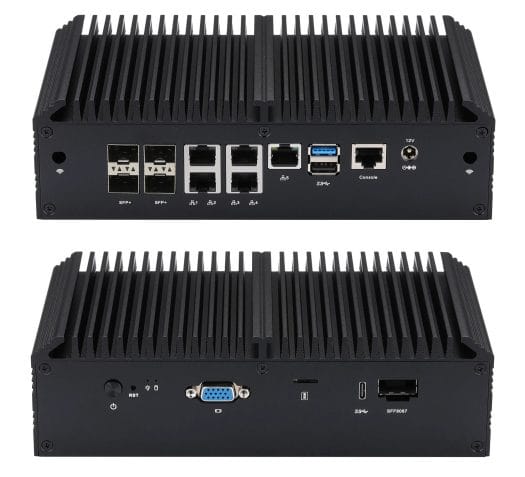
Qotom Q20332G9-S10: Fanless Mini PC with 4 10GbE and 5 2.5GbE Ports

Qotom Q20332G9-S10: Fanless Mini PC with 4 10GbE and 5 2.5GbE Ports

The Qotom Q20332G9-S10 is a fanless mini PC that can be sued as a router, due to the fact that it features four 10GbE SFP+ cages and five 2.5GbE RJ45 ports, making it a suitable network appliance. The system is powered by an Atom C3758R Denverton Refresh eight-core processor.

In terms of specifications, the Qotom Q20332G9-S10 supports up to 64GB DDR4 memory and has two M.2 NVMe SSD sockets, as well as two 2.5-inch SATA bays for storage. It also includes one extra M.2 socket for cellular connectivity and several USB ports. The system is equipped with a VGA port for video output.

The Qotom Q20332G9-S10 comes with a 12V/5A power supply and a VESA mount. It can be purchased as a barebone system or with pre-installed RAM and SSD. It is available for around $300 on Amazon and Aliexpress in its barebone configuration, with variants offering up to 64GB RAM and 2TB SSD.

Source: CNX Software – Embedded Systems News.

Banana Pi BPI-R4: WiFi 7 Router Board Powered by MediaTek Filogic 880 Processor

Banana Pi has released a new WiFi 7 router board called the BPI-R4. This router board is powered by the MediaTek MT7988A (Filogic 880) quad-core Arm Corex-A73 processor. It features 4GB DDR4 RAM, 8GB eMMC flash, and 128MB SPI-NAND flash.

The BPI-R4 also includes two 10GbE SFP cages, four Gigabit Ethernet RJ45 ports, a USB 3.2 port, an M.2 socket for a 4G/5G modem or an NVMe SSD, and two mini PCIe slots with PCIe 3.0 to support WiFi 7.

The specifications of the Banana Pi BPI-R4 are as follows:

  • SoC: MediaTek MT7988A (Filogic 880) quad-core Arm Corex-A73 processor @ 1.8GHz with AI-powered packet accelerator
  • System Memory: 4GB DDR4
  • Storage: 8GB eMMC flash, 128MB SPI NAND Flash, microSD card slot, M.2 Key M for NVMe SSD
  • Networking: 2x 10GbE SFP cages, 4x Gigabit Ethernet RJ45 ports
  • USB: USB 3.2 port
  • Expansion: M.2 Key-B slot with USB 3.2 interface for 5G or 4G LTE connectivity, M.2 Key-M slot with 1-lane PCIe 3.0 for NVMe SSD, 2x mini PCIe slots with 2-lane PCIe 3.0 for Wi-Fi 7 NIC, 26-pin GPIO header for expansion
  • Debugging: 3-pin header for 3.3V serial console
  • Misc: Reset button, WPS button, bootstrap switch, RTC battery connector
  • Power Supply: 12V/5.2A or 19V/3.2A via DC jack, 20V DC input via header, optional PoE module (RT5400), 5V/12V output header
  • Dimensions: 148 x 100.5 mm
  • Weight: 250 grams

The Banana Pi BPI-R4 currently has three OpenWrt images available for eMMC, NAND flash, or microSD card boot. A Debian image is also in development. The board does not come with a WiFi 7 module by default but can support it through the two mini PCIe sockets.

The WiFi 7 iPA NIC Module, which can be added to the BPI-R4, is based on a four-chip design with MediaTek MT7996 (WiFi 7 tri-band BE19000 SoC), MT7995N (2.4 GHz WiFi), MT7977AN (6 GHz), and MT7977B (6 GHz).

The Banana Pi BPI-R4 is available for purchase on Aliexpress for $103.15, but the WiFi 7 card must be purchased separately. Coupon codes are available for discounts during the Black Friday promotion.

Overall, the Banana Pi BPI-R4 is a powerful WiFi 7 router board with a range of features and expandability options.

Source: CNX Software – Embedded Systems News.

Netgate Launches Latest pfSense CE Software Version 2.7.1

Netgate, the provider of pfSense Community Edition (CE) software, has announced the release of version 2.7.1. pfSense CE is an open-source project that has been supported by Netgate since 2008. The source code for the project is available on GitHub under the Apache 2.0 open-source license. pfSense CE can be used on common hardware to build routers and more.

One major change in this release is the upgrade of OpenSSL to version 3.0.12. This upgrade was necessary as OpenSSL 1.1.1 has reached its End of Life and will no longer receive security patches. With the upgrade to OpenSSL 3.0.12, older and weaker encryption and hash algorithms have been removed, and security certificates based on these algorithms have been deprecated. It is highly recommended to review the release notes and Netgate’s blog post on this topic before performing the upgrade.

Another notable feature in version 2.7.1 is the addition of Kea DHCP as an opt-in feature. While basic functionality is present, it is not yet feature-complete. Switching to the Kea DHCP server can be done through the web interface by navigating to System > Advanced and changing the server backend radio button in the DHCP Options section to “Kea DHCP”. It is important to note that switching to Kea DHCP may result in ignored hostnames for devices on the network that were assigned using static leases or rely on dynamic lease registration in DNS.

This release also includes improved support for SCTP (Stream Control Transmission Protocol) in PF for firewall rules, NAT, and logging. Rules can now act on SCTP packets by port number, whereas previously it was only possible to filter on source or destination address. Additionally, the IPv6 Router Advertisement configuration has been relocated to Services > Router Advertisement as part of the ongoing integration of the Kea DHCP server.

Other changes in version 2.7.1 include the upgrade of PHP to version 8.2.11 and the base operating system to a more recent point of FreeBSD 14-CURRENT. The release also addresses various bugs and issues.

Source: pfSense.

Netgate Launches pfSense CE Software Version 2.7.1 Release Candidate

Netgate has announced the Release Candidate (RC) of pfSense CE software version 2.7.1. This open-source project, supported by Netgate since 2008, is a widely-used firewall and routing platform. The RC release is an opportunity for users to try out the new version and provide feedback.

The major changes and features in pfSense CE software version 2.7.1 include:

  1. Upgraded OpenSSL to version 3.0.12: This upgrade was necessary as OpenSSL 1.1.1 has reached its End of Life and will no longer receive security patches. The upgrade removes older and weaker encryption and hash algorithms, improving security.

  2. Kea DHCP added as an opt-in feature: The Kea DHCP server is now available as an optional feature. While it is not feature complete in this version, users can switch to Kea DHCP by navigating to the System > Advanced menu and changing the DHCP Options to “Kea DHCP”. However, switching to Kea DHCP may result in the ignoring of assigned hostnames and dynamic lease registration in DNS.

  3. Improved support for SCTP: Support for SCTP in firewall rules, NAT, and logging has been enhanced. Users can now filter SCTP packets by port number, in addition to source and destination address.

  4. IPv6 Router Configuration moved: The IPv6 Router Advertisement configuration has been relocated to Services > Router Advertisement as part of the integration with the Kea DHCP server.

Other changes in this release include upgrading PHP to version 8.2.11, upgrading the base operating system to a more recent point of FreeBSD 14-CURRENT, and addressing various bugs and issues.

Testing of the RC software release is crucial to ensure its reliability and robustness for all users. Netgate encourages users to download and test the release candidate, and provide feedback on any issues they encounter.

To install the upgrade, users can follow the detailed Upgrade Guide available in the pfSense documentation. It is recommended to back up the pfSense CE configuration prior to the upgrade. The upgrade can be performed through the web interface by navigating to System > Update and setting the Branch to “Next Stable Version (2.7.1-RC)”.

OpenWrt 23.05 Release: Enhanced Security, Rust Integration and Broad Device Support

OpenWrt 23.05, the open-source Linux operating system for routers and resource-constrained headless embedded systems, has just been released with significant updates and improvements. This release comes with over 4300 commits since the previous release of OpenWrt 22.03, which was launched a little over a year ago.

One of the notable features of OpenWrt 23.05 is its expanded device support. It now supports over 1790 devices, which is an increase of about 200 devices compared to the previous release. Some of the new targets include the Qualcomm IPQ807x target for WiFi 6 SoCs, the Mediatek Filogic 830 and 630 subtarget for WiFi 6/6e chips, and the HiFive Unleashed and Unmatched targets for RISC-V development boards.

In terms of security, OpenWrt 23.05 has switched from using wolfSSL to MbedTLS as the default. This change was made because MbedTLS has a smaller footprint and offers a more stable ABI and LTS releases. However, it’s worth noting that MbedTLS lacks support for TLS 1.3. Therefore, users who require TLS 1.3 can still switch to using wolfSSL.

Another significant addition in this release is support for packages written with the Rust programming language. Some examples of these packages include bottom, maturin, aardvark-dns, and ripgrep. This expansion of supported programming languages provides developers with more flexibility and options when creating applications for OpenWrt.

OpenWrt 23.05 also brings updates to its core components. It now utilizes Linux 5.15 as the foundation for all targets, as well as updated versions of busybox, musl libc, glibc, gcc, and inutils. Additionally, the networking components have seen upgrades, including the use of the hostapd master snapshot from September 2023, dnsmasq 2.89, dropbear 2022.82, and cfg80211/mac80211 from kernel 6.1.24.

For users looking to upgrade from OpenWrt 22.03, the migration from swconfig to DSA configuration that was introduced in the previous releases is no longer an issue. Most people should be able to upgrade smoothly using the sysupgrade utility, which will preserve the configuration. However, it is still recommended to back up the configuration before proceeding with the upgrade.

OpenWrt 23.05 is now available for download, and users can find binary images for their specific targets on the OpenWrt website.

Source: CNX Software – Embedded Systems News.