Posts for: #ryzen

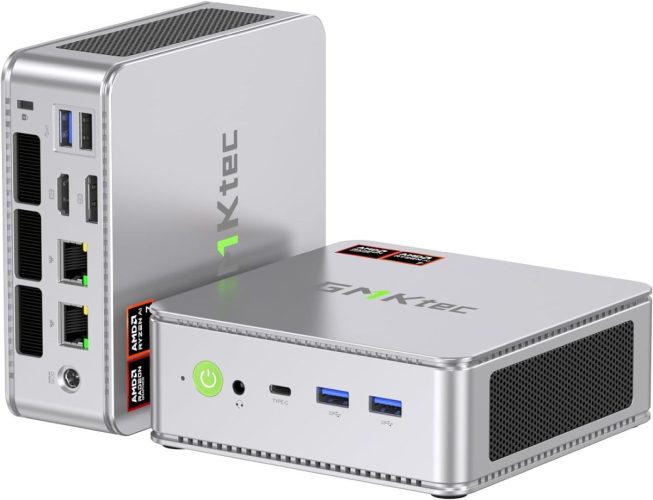
GMK NucBox K8 Mini PC with Ryzen 7 8845HS Processor Available starting at $500

GMK NucBox K8 Mini PC with Ryzen 7 8845HS Processor Available starting at $500

GMK NucBox K8, a compact computer featuring an AMD Ryzen 7 8845HS processor. It’s a versatile option for those interested in servers, Linux, DevOps, and home labs due to its robust specifications. The mini PC supports DDR5-5600 memory through two SODIMM slots and offers two M.2 2280 slots for PCIe 4.0 NVMe solid state drives. The connectivity options are comprehensive, including USB4 with DisplayPort Alt Mode, HDMI, DisplayPort, and 2.5 Gb Ethernet.

Specifications for the GMK NucBox K8 include:

  • AMD Ryzen 7 8845HS processor
  • Two SODIMM slots for DDR5-5600 memory
  • Two M.2 2280 slots for PCIe 4.0 NVMe SSDs
  • 1 x USB4 (w/DisplayPort Alt Mode and 100W USB power delivery)
  • 2 x USB 3.2 Gen 2 Type-A
  • 1 x USB 3.2 Gen 1 Type-A
  • 1 x USB 2.0 Type-A
  • 1 x DisplayPort 1.4
  • 1 x HDMI 2.0
  • 2 x 2.5 Gbps Ethernet ports
  • 1 x 3.5mm audio jack
  • AMD RZ616 wireless card with WiFi 6E and Bluetooth 5.2 support

The device measures 129 x 127 x 48mm and features an active cooling system with two fans, allowing the Ryzen 7 8845HS processor to run at up to 65 watts for better sustained performance.

Pricing starts at $500 for a barebones configuration, with options for 32GB of RAM and up to 2TB of storage available.

Source: Liliputing.
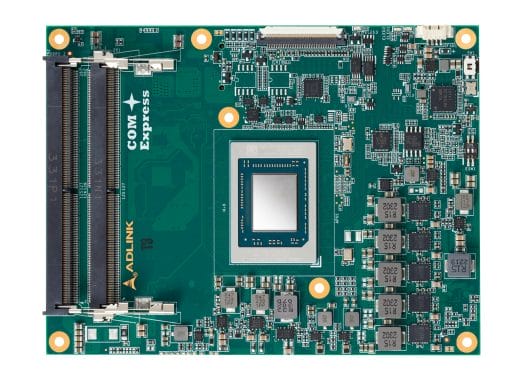
ADLINK AMD Ryzen Embedded V3000 COM Express Type 7 Module: Supports 64GB DDR5 Memory

ADLINK AMD Ryzen Embedded V3000 COM Express Type 7 Module: Supports 64GB DDR5 Memory

ADLINK has introduced the Express VR7, a COM Express Basic size Type 7 computer-on-module that is powered by the eight-core AMD Ryzen Embedded V3000 processor. The module features two 10GbE interfaces, fourteen PCIe Gen 4 lanes, and optional support for an “extreme temperature range” between -40°C and 85°C.

The ADLINK Express VR7 supports up to 64GB dual-channel DDR5 SO-DIMM memory (ECC/non-ECC). It is designed for headless embedded applications such as edge networking equipment, 5G infrastructure at the edge, video storage analytics, intelligent surveillance, industrial automation and control, and rugged edge servers.

Specifications:

  • SoC: AMD Embedded Ryzen V3000
    • Ryzen V3C48 8-core/16-thread processor @ 3.3/3.8GHz; TDP: 45W
    • Ryzen V3C44 4-core/8-thread processor @ 3.5/3.8GHz; TDP: 45W
    • Ryzen V3C18I 8-core/16-thread processor 1.9/3.8GHz; TDP: 15W (useful in the extreme temperature range)
    • Ryzen V3C16 6-core/12-thread processor 2.0/3.8GHz; TDP: 15W
    • Ryzen V3C14 4-core/8-thread processor 2.3/3.8GHz; TDP: 15W
  • System Memory: Up to 64GB (2x 32GB) dual-channel ECC/non-ECC DDR5 memory up to 4800 MT/s via two SODIMM sockets
  • On-module chips:
    • Embedded BIOS: AMI UEFI with CMOS backup in 32 or 16MB (TBC) SPI BIOS (dual BIOS by build option)
    • Intel i226 2.5GbE controller
  • 2x 220-pin connectors with:
    • Storage: 2x SATA III 6 Gbps
    • Networking:
      • 2x 10GBASE-KR and its sideband signals
      • 1x 2.5GbE interface
    • USB: 4x USB 3.x/2.0/1.1
    • Expansion buses:
      • 8x PCI Express Gen4: Lanes 16-23 (configurable to one x8, two x4, two controller)
      • 4x PCI Express Gen4: Lanes 0-3 (configurable to four x1, two x2, one x4, four controller)
      • 2x PCI Express Gen4: Lanes 4-5 (configurable to one x1, one x2, one controller)
      • LPC bus (through an ESPI to LPC bridge IC), SMBus (system), I2C (user), GP_SPU (user, project basis)
    • Serial: 2x UART ports with console redirection
    • IOs: 4x GPO and 4x GPI (with interrupt)
  • SEMA Board Controller: Voltage/current monitoring, power sequence debug support, AT/ATX mode control, logistics and forensic information, flat panel control, general purpose I2C, watchdog timer, fan control and failsafe BIOS (dual BIOS by build option)
  • Optional IPMB (in conjunction with carrier BMC for remote management Controller applications) by build option
  • Super I/O: Supported on carrier if needed (standard support for W83627DHG-P, other Super I/O supported on request)
  • Debug Headers: 40-pin multipurpose flat cable connector for use with DB40-HPC debug module providing BIOS POST code LED, EC access, SPI BIOS flashing, power testpoints, debug LEDs
  • Security: Infineon TPM 2.0 (SPI based)
  • Power Management:
    • Standard Input: ATX: 12V±5% / 5Vsb ±5%; or AT: 12V±5%
    • ACPI 5.0 compliant
    • Power States: C1-C6, S0, S1, S3, S4, S5, S5 ECO mode (Wake on USB S3/S4, WOL S3/S4/S5)
  • Dimensions: 125 x 95 mm (PICMG COM.0: Rev 3.1 Type 7 Basic size)
  • Temperature Range:
    • Operating: Standard: 0°C to 60°C; Extreme Rugged: -45°C to 85°C (build option, selected SKUs)
    • Storage: Standard: -20°C to 80°C; Extreme Rugged: -40°C to 85°C
  • Humidity:
    • 5-90% RH operating, non-condensing
    • 5-95% RH storage (and operating with conformal coating)
  • Shock and Vibration:
    • IEC 60068-2-64 and IEC-60068-2-27
    • MIL-STD-202F, Method 213B, Table 213-I, Condition A and Method 214A, Table 214-I, Condition D
  • HALT: Thermal Stress, Vibration Stress, Thermal Shock and Combined Test

ADLINK provides standard support for Yocto Linux and Ubuntu 20.04.3 LTS, as well as extended support for Yocto Project-based Linux. The company plans to offer I-Pi development kits based on the Express-VR7 module for easy prototyping and evaluation.

The availability of the Express-VR7 COM Express module based on the AMD Ryzen Embedded V3000 SoC has not been confirmed at this time. Additional details can be found on the product page.

Source: CNX Software – Embedded Systems News.

AOOSTAR PRO: A 4-Bay NAS Featuring Ryzen 7 5700U, N100, and Core i3-N305 Processor Options

AOOSTAR, a Chinese mini PC manufacturer, has unveiled the AOOSTAR PRO 4 Bay NAS, a new network-attached-storage system. The device, set for pre-order availability in early January 2023, provides users with a choice of three different processors. The NAS system boasts a metal chassis and offers options for barebones or fully configured models. Configured versions come with pre-installed memory and storage.

While the company has not yet disclosed the price of the AOOSTAR PRO 4-Bay NAS, some specifications have been provided:

  • Processor options: N100, N305, or Ryzen 7 5700U
  • RAM: DDR4-3200 single-channel or DDR4-3200 dual-channel
  • HDD storage: 4-bays for 2.5 or 3.5" hard drives
  • SSD storage: Up to 2 x M.2 NVMe
  • Ethernet: 2 x 2.5 GbE
  • Wireless: WiFi 6 and BT 5.2
  • USB: 1 x USB Type-C, 2 x USB 3.2 Gen 2 Type-A, and 2 x USB 2.0 Type-A

More details about the AOOSTAR PRO 4-Bay NAS are expected to be revealed closer to the launch date.

Source: Liliputing.

AMD Unveils Powerful Ryzen Embedded 7000 Series Processors

AMD has unveiled its latest addition to the Zen 4 family, the Ryzen Embedded 7000 series processors. These socketed CPUs are designed for embedded and edge applications in the 60~105 Watt space. The Ryzen Embedded 7000 series processors offer significant improvements over the previous generation Ryzen Embedded 5000 series parts. They feature up to 12 cores and 24 threads, TDPs ranging from 65 to 105 Watts, support for DDR5-5200 ECC memory, up to 28 lanes on-chip for PCIe Gen5, and integrated RDNA2 graphics. AMD is committed to providing up to seven years of support for these processors. Linux, particularly Ubuntu, is the preferred operating system for these embedded processors.

The Ryzen Embedded 7000 series processors come with a range of models, from the Ryzen Embedded 7645 to the Ryzen Embedded 7700X. The flagship model, the Ryzen Embedded 7945, is a 65 Watt part with 12 cores, 24 threads, a base frequency of 3.7GHz, a boost frequency of 5.4GHz, and 64MB L3 cache. Unfortunately, there are no technical benchmarks available yet, but AMD claims significant performance advantages over Intel Raptor Lake on Windows.

The chipset options for the Ryzen Embedded 7000 series are the X600, B650, and X670. It is worth noting that these processors do not have Ryzen AI, although there is a possibility that future generations may support it on Linux.

Overall, the AMD Ryzen Embedded 7000 series processors offer a powerful and efficient solution for embedded and edge applications. With their improved performance and support for Linux, they are likely to find popularity in the embedded space.

Source: Phoronix.

GEEKOM A5 Mini PC with AMD Ryzen 7 5800H

GEEKOM has released the A5, a mini PC powered by an AMD Ryzen 7 5800H processor, with 32GB RAM and a 512GB SSD.

The GEEKOM A5 mini PC boasts impressive features, including support for up to four 4K displays through two HDMI 2.0 outputs and two USB-C (USB 3.2 Gen 2) ports. It also offers 2.5Gbps Ethernet and WiFi 6 networking capabilities. The mini PC is equipped with three USB 3.2 Gen 2 Type-A ports, one USB 2.0 port, and a 3.5mm audio jack.

Here are the detailed specifications of the GEEKOM A5 mini PC:

  • SoC – AMD Ryzen 7 5800H 8-core/16-thread processor up to 3.2 GHz / 4.4 GHz (Turbo) with 16MB cache, AMD Radeon Vega 8 Graphics; TDP: 35W
  • System Memory – 32GB RAM via dual-channel DDR4-3200 SODIMM
  • Storage:
    • 512GB M.2 2280 PCIe Gen 3×4 NVMe SSD, upgradable to 2TB NVMe or SATA SSD
    • 2.5-inch SATA HDD slot (7mm thick max) up to 2TB
    • Full-size SD card slot
  • Video Output:
    • 2 x HDMI 2.0 ports up to 4Kp60Hz
    • 2x DisplayPort via USB Type-C ports up to 8Kp30
  • Audio – 3.5mm audio jack, digital audio via HDMI and USB-C
  • Networking:
    • 2.5GbE RJ45 port
    • WiFi 6 and Bluetooth 5.2
  • USB:
    • 3x USB 3.2 Gen 2 Type-A ports
    • 1x USB 2.0 Type-A port
    • 2x USB 3.2 Gen 2 Type-C ports with DisplayPort alt mode
  • Misc – Power button, Kensington Lock slot
  • Power Supply – 19V/6.32A (120W Power Adapter) via DC jack
  • Dimensions – 117 x 112 x 49.2 mm
  • Weight – 652 grams

The GEEKOM A5 mini PC comes with an activated version of Windows 11 Pro and several accessories, including a user guide, a VESA mount, an HDMI cable, and a 120W power adapter. We had the opportunity to review a sample unit of the A5, and we can confirm that it utilizes a 512GB Lexar NVMe (PCIe Gen 3 x4) SSD, as shown in the teardown photos.

Overall, the GEEKOM A5 mini PC offers good specifications and features at an affordable price point. It seems like a good option for those interested in a low power server.

AMD Introduces Smaller Zen 4c CPU Cores in Latest Ryzen 7040U Mobile Chips

AMD has released its latest mobile chips, the Ryzen 5 7545U and Ryzen 3 7440U, which are the first laptop processors to feature AMD’s new Zen 4c CPU cores. These cores were previously seen in the EPYC server chips and the entry-level AMD Ryzen Z1 chip for handheld gaming PCs. The Zen 4c cores offer most of the same features as Zen 4 cores but take up less space and run at lower speeds. AMD claims that the Zen 4c cores take up 35% less physical space than Zen 4, allowing for more cores in the same amount of space or the same number of cores in a smaller space.

The Ryzen 5 7545U and Ryzen 3 7440U chips replace the previous Ryzen 5 7540U and Ryzen 3 7440U Phoenix chips. The new chips still have the same number of CPU cores (6 for Ryzen 5 and 4 for Ryzen 3), but now some of those cores are Zen 4c chips, which should bring efficiency improvements and similar performance at lower power levels. The top speeds for the Zen 4c cores are not known, but they are estimated to be about 30% slower than Zen 4 cores.

The updated Ryzen 7040U lineup includes the following chips:

  • Ryzen 7 7840U: 8 x Zen 4 cores, 8 / 16 cores / threads, 3.3 GHz / 5.1 GHz base / boost CPU frequency, 24MB cache, Radeon 780M graphics, DDR5 / LPDDR5 RAM, USB4 support, 15-30W TDP.
  • Ryzen 5 7640U: 6 x Zen 4 cores, 6 / 12 cores / threads, 3.5 GHz / 4.9 GHz base / boost CPU frequency, 22MB cache, Radeon 760M graphics, DDR5 / LPDDR5 RAM, USB4 support, 15-30W TDP.
  • Ryzen 5 7540U: 6 x Zen 4 cores, 6 / 12 cores / threads, 3.2 GHz / 4.9 GHz base / boost CPU frequency, 22MB cache, Radeon 740M graphics, DDR5 / LPDDR5 RAM, USB4 support, 15-30W TDP.
  • Ryzen 5 7545U: 2 x Zen 4 cores, 4 x Zen 4c cores, 6 / 12 cores / threads, 3.2 GHz / 4.9 GHz base / boost CPU frequency, 22MB cache, Radeon 740M graphics, DDR5 / LPDDR5 RAM, USB4 support, 15-30W TDP.
  • Ryzen 3 7440U (old): 4 x Zen 4 cores, 4 / 8 cores / threads, 3 GHz / 4.7 GHz base / boost CPU frequency, 12MB cache, Radeon 740M graphics, DDR5 / LPDDR5 RAM, USB4 support, 15-30W TDP.
  • Ryzen 3 7440U (new): 1 x Zen 4 core, 3 x Zen 4c cores, 4 / 8 cores / threads, 3 GHz / 4.7 GHz base / boost CPU frequency, 12MB cache, Radeon 740M graphics, DDR5 / LPDDR5 RAM, USB4 support, 15-30W TDP.

Source: Liliputing.