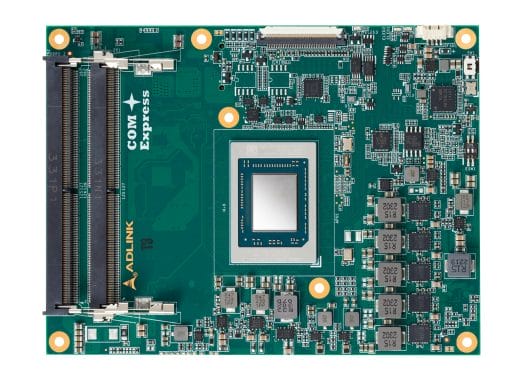
ADLINK has introduced the Express VR7, a COM Express Basic size Type 7 computer-on-module that is powered by the eight-core AMD Ryzen Embedded V3000 processor. The module features two 10GbE interfaces, fourteen PCIe Gen 4 lanes, and optional support for an “extreme temperature range” between -40°C and 85°C.
The ADLINK Express VR7 supports up to 64GB dual-channel DDR5 SO-DIMM memory (ECC/non-ECC). It is designed for headless embedded applications such as edge networking equipment, 5G infrastructure at the edge, video storage analytics, intelligent surveillance, industrial automation and control, and rugged edge servers.
Specifications:
- SoC: AMD Embedded Ryzen V3000
- Ryzen V3C48 8-core/16-thread processor @ 3.3/3.8GHz; TDP: 45W
- Ryzen V3C44 4-core/8-thread processor @ 3.5/3.8GHz; TDP: 45W
- Ryzen V3C18I 8-core/16-thread processor 1.9/3.8GHz; TDP: 15W (useful in the extreme temperature range)
- Ryzen V3C16 6-core/12-thread processor 2.0/3.8GHz; TDP: 15W
- Ryzen V3C14 4-core/8-thread processor 2.3/3.8GHz; TDP: 15W
- System Memory: Up to 64GB (2x 32GB) dual-channel ECC/non-ECC DDR5 memory up to 4800 MT/s via two SODIMM sockets
- On-module chips:
- Embedded BIOS: AMI UEFI with CMOS backup in 32 or 16MB (TBC) SPI BIOS (dual BIOS by build option)
- Intel i226 2.5GbE controller
- 2x 220-pin connectors with:
- Storage: 2x SATA III 6 Gbps
- Networking:
- 2x 10GBASE-KR and its sideband signals
- 1x 2.5GbE interface
- USB: 4x USB 3.x/2.0/1.1
- Expansion buses:
- 8x PCI Express Gen4: Lanes 16-23 (configurable to one x8, two x4, two controller)
- 4x PCI Express Gen4: Lanes 0-3 (configurable to four x1, two x2, one x4, four controller)
- 2x PCI Express Gen4: Lanes 4-5 (configurable to one x1, one x2, one controller)
- LPC bus (through an ESPI to LPC bridge IC), SMBus (system), I2C (user), GP_SPU (user, project basis)
- Serial: 2x UART ports with console redirection
- IOs: 4x GPO and 4x GPI (with interrupt)
- SEMA Board Controller: Voltage/current monitoring, power sequence debug support, AT/ATX mode control, logistics and forensic information, flat panel control, general purpose I2C, watchdog timer, fan control and failsafe BIOS (dual BIOS by build option)
- Optional IPMB (in conjunction with carrier BMC for remote management Controller applications) by build option
- Super I/O: Supported on carrier if needed (standard support for W83627DHG-P, other Super I/O supported on request)
- Debug Headers: 40-pin multipurpose flat cable connector for use with DB40-HPC debug module providing BIOS POST code LED, EC access, SPI BIOS flashing, power testpoints, debug LEDs
- Security: Infineon TPM 2.0 (SPI based)
- Power Management:
- Standard Input: ATX: 12V±5% / 5Vsb ±5%; or AT: 12V±5%
- ACPI 5.0 compliant
- Power States: C1-C6, S0, S1, S3, S4, S5, S5 ECO mode (Wake on USB S3/S4, WOL S3/S4/S5)
- Dimensions: 125 x 95 mm (PICMG COM.0: Rev 3.1 Type 7 Basic size)
- Temperature Range:
- Operating: Standard: 0°C to 60°C; Extreme Rugged: -45°C to 85°C (build option, selected SKUs)
- Storage: Standard: -20°C to 80°C; Extreme Rugged: -40°C to 85°C
- Humidity:
- 5-90% RH operating, non-condensing
- 5-95% RH storage (and operating with conformal coating)
- Shock and Vibration:
- IEC 60068-2-64 and IEC-60068-2-27
- MIL-STD-202F, Method 213B, Table 213-I, Condition A and Method 214A, Table 214-I, Condition D
- HALT: Thermal Stress, Vibration Stress, Thermal Shock and Combined Test
ADLINK provides standard support for Yocto Linux and Ubuntu 20.04.3 LTS, as well as extended support for Yocto Project-based Linux. The company plans to offer I-Pi development kits based on the Express-VR7 module for easy prototyping and evaluation.
The availability of the Express-VR7 COM Express module based on the AMD Ryzen Embedded V3000 SoC has not been confirmed at this time. Additional details can be found on the product page.
Source: CNX Software – Embedded Systems News.