Posts for: #self-host

README Highlight Issue #50, 2023: memos

README Highlight Issue #50, 2023: memos

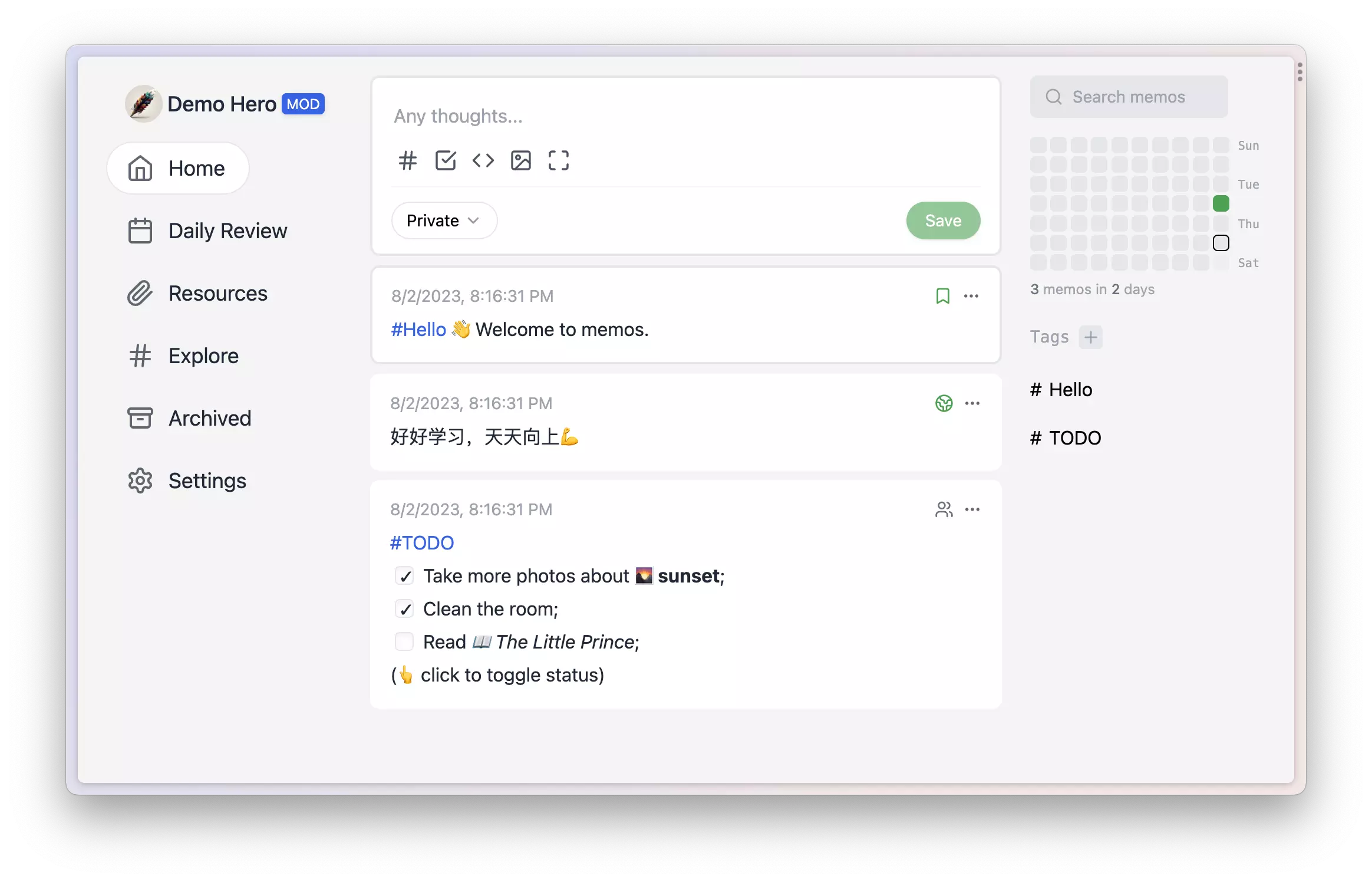
In this week’s issue of README Highlight (#50, 2023), we are taking a look at the following project: memos.

The memos project is a privacy-first, lightweight note-taking service that allows users to easily capture and share their great thoughts. It is designed for individuals who value their privacy and prefer a minimalist approach to note-taking.

Some key points about memos include:

  • Open source and free forever: memos is an open-source solution that is available for free, ensuring that creativity knows no boundaries.
  • Self-hosting with Docker in just seconds: With Docker, users can easily deploy memos and have full control over their data and privacy.
  • Pure text with added Markdown support: memos focuses on simplicity by providing a pure text interface with support for Markdown formatting.
  • Customize and share notes effortlessly: memos offers intuitive sharing features that allow users to collaborate and distribute their notes with others.
  • RESTful API for third-party services: memos provides a RESTful API that enables integration with other services, opening up new possibilities.

To deploy memos with Docker, users can use the following command:

docker run -d --name memos -p 5230:5230 -v~/.memos/:/var/opt/memos ghcr.io/usememos/memos:latest

The ~/.memos/ directory serves as the data directory on the local machine, while /var/opt/memos is the directory of the volume in Docker and should not be modified.

Contributions to the memos project are greatly appreciated, as they help make the open-source community a vibrant place to learn, inspire, and create.

The project has also gained popularity and has been contributed to by various developers. Some notable contributions include:

In conclusion, memos is a privacy-focused note-taking service that offers a simple and customizable experience. With its open-source nature and support for Docker deployment, memos provides users with full control over their data and privacy. Whether you are a developer, a DevOps enthusiast, or someone who enjoys maintaining a home lab, memos can be a valuable tool for capturing and sharing your thoughts.

Source: memos README.

Self-hosted Monthly Update November 2023

Here are the new additions to the awesome-selfhosted repository during the month of November 2023:

  • ZOT OCI Registry - A production-ready vendor-neutral OCI-native container image registry. (Demo, Source Code) Apache-2.0 Go/Docker
  • mikochi - Browse remote folders, upload files, delete, rename, download and stream files to VLC/mpv. MIT Go/Docker/K8S
  • Digimindmap - Create simple mindmaps (documentation in French). (Demo, Source Code) AGPL-3.0 Nodejs/PHP
  • Piler - Feature-rich email archiving solution. (Source Code) GPL-3.0 C
  • OpenTrashmail - Complete trashmail solution that exposes an SMTP server and has a web interface to manage received emails. Works with multiple and wildcard domains and is fully file based (no database needed). Includes RSS feeds and JSON API. Apache-2.0 Python/PHP/Docker
  • Digiwall - Create multimedia collaborative walls for in-person or remote work (documentation in French). (Source Code) AGPL-3.0 Nodejs
  • Digibunch - Create bunches of links to share with your learners or colleagues. (Demo, Source Code) AGPL-3.0 Nodejs/PHP
  • Digiview - View YouTube videos in a distraction-free interface (documentation in French). (Demo, Source Code) AGPL-3.0 Nodejs/PHP
  • Slash - An open source, self-hosted bookmarks and link sharing platform. GPL-3.0 Docker
  • Docuseal - Create, fill, and sign digital documents (alternative to DocuSign). (Demo, Source Code) AGPL-3.0 Docker
  • Librum - A modern e-book reader and library manager that supports most major book formats, runs on all devices and offers great tools to boost productivity. (Source Code) GPL-3.0 C++
  • Suroi - An open-source 2D battle royale game inspired by surviv.io. (Demo, Source Code) GPL-3.0 Nodejs
  • Homebox Inventory - An inventory and organization system built for the home user with a focus on simplicity and ease of use. (Demo, Source Code) AGPL-3.0 Docker
  • ESMira - Run longitudinal studies (ESM, AA, EMA) with data collection and communication with participants being completely anonymous. (Demo, Source Code) AGPL-3.0 PHP
  • LanguageTool - Proofread more than 20 languages. It finds many errors that a simple spell checker cannot detect. (Source Code, Clients) LGPL-2.1 Java/Docker
  • Kestra - Event-driven, language-agnostic platform to create, schedule, and monitor workflows. In code. Coordinate data pipelines and tasks such as ETL and ELT. (Source Code) Apache-2.0 Docker
  • Digitools - A set of simple tools to accompany the animation of courses in person or remotely. (documentation in French). (Demo, Source Code) AGPL-3.0 PHP
  • SentryShot - Video surveillance management system. GPL-2.0 Docker/Rust
  • Otter Wiki - Simple, easy to use wiki software using markdown. MIT Docker
  • Digiscreen - Interactive whiteboard/wallpaper for the classroom, in person or remotely (documentation in French). (Demo, Source Code) AGPL-3.0 Nodejs/PHP
  • StartOS - Browser-based, graphical Operating System (OS) that makes running a personal server as easy as running a personal computer. (Source Code) MIT Rust
  • DocKing - Document management service/microservice that handles templates and renders them in PDF format, all in one place. (Demo, Source Code) MIT PHP/Nodejs/Docker
  • Flyimg - Resize and crop images on the fly. Get optimised images with MozJPEG, WebP or PNG using ImageMagick, with an efficient caching system. (Demo, Source Code) MIT Docker

awesome-selfhosted is a repository on GitHub, which contains ton of software for you to self-host. The repository describes itself as “a list of Free Software network services and web applications which can be hosted on your own servers.”

If you need a server on which to host your own applications, consider a Raspberry Pi or a mini PC.

Self-hosted Monthly Update October 2023

Here are the new additions to the awesome-selfhosted repository during the month of October 2023:

  • inlets - Expose your local endpoints to the Internet - with a Kubernetes integration, Docker image and CLI available. (Source Code) ⊘ Proprietary Go/Docker
  • Servas - A self-hosted bookmark management tool. It allows organization with tags, groups, and a list specifically for later access. It supports multiple users with 2FA. Companion browser extensions are available for Firefox and Chrome. (Clients) GPL-3.0 Docker/Nodejs/PHP Software and tools to help with resource and supply planning, including enterprise resource and supply planning (ERP).
  • Cluster Control - Setup many databases in few clicks with monitoring, load balancing and more. ⊘ Proprietary deb/Ansible/Shell/Docker
  • Dashpress - Generate fully functional admin apps in seconds from your database information, with a single command. (Demo) AGPL-3.0 Nodejs/Docker
  • Galette - Galette is a membership management web application towards non profit organizations. (Source Code) GPL-3.0 PHP
  • rs-short - A lightweight link shortener written in Rust, with features such as caching, spambot protection and phishing detection. (Demo) MPL-2.0 Rust
  • BrowserStack Automate TurboScale - Scalable browser automation grid on your cloud (AWS, GCP and Azure) supporting Selenium and Playwright. ⊘ Proprietary Docker
  • OctoBot - Open-source cryptocurrency trading bot. (Source Code) GPL-3.0 Python/Docker Video surveillance, also known as Closed-circuit television (CCTV), is the use of video cameras for surveillance in areas that require additional security or ongoing monitoring.
  • Owncast - Decentralized single-user live video streaming and chat server for running your own live streams similar in style to the large mainstream options. (Source Code) MIT Go
  • CNCjs - A web-based interface for CNC milling controller running Grbl, Smoothieware, or TinyG. (Source Code) MIT Nodejs Software to manage 3D printers, CNC machines and other physical manufacturing tools.
  • Fluidd - Lightweight & responsive user interface for Klipper, the 3D printer firmware. (Source Code) GPL-3.0 Docker/Nodejs
  • Mainsail - A modern and responsive user interface for the Klipper 3D printer firmware. Control and monitor your printer from everywhere, from any device. (Source Code) GPL-3.0 Docker/Python
  • Octoprint - A snappy web interface for controlling consumer 3D printers. (Source Code) AGPL-3.0 Docker/Python
  • Deluge - Lightweight, cross-platform BitTorrent client. (Source Code) GPL-3.0 Python/deb
  • Specifically Clementines - Grocery shopping app (previously Groceries), providing reliable sync with multiple users/devices (web/Android/iOS), recipes and integration with Tandoor. (Demo, Source Code) MIT Docker

awesome-selfhosted is a repository on GitHub, which contains ton of software for you to self-host. The repository describes itself as “a list of Free Software network services and web applications which can be hosted on your own servers.”

Self-hosted Monthly Update September 2023

Here are the new additions to the awesome-selfhosted repository during the month of September 2023:

  • FreedomBox - Community project to develop, design and promote personal servers running free software for private, personal, communications. (Source Code) AGPL-3.0 Python/deb
  • INGInious - Intelligent grader that allows secured and automated testing of code made by students. (Source Code, Clients) AGPL-3.0 Python/Docker
  • Websurfx - Aggregate results from other search engines (metasearch engine) without ads while keeping privacy and security in mind. It is extremely fast and provides a high level of customization (alternative to SearX). AGPL-3.0 Rust/Docker
  • Mataroa - Mataroa is a naked blogging platform for minimalists. (Source Code) MIT Python
  • Flipt - Feature flag solution with support for multiple data backends (alternative to LaunchDarkly). (Demo, Source Code) GPL-3.0 Docker/K8S/Go

awesome-selfhosted is a repository on GitHub, which contains ton of software for you to self-host. The repository describes itself as “a list of Free Software network services and web applications which can be hosted on your own servers.”

If you need a device for self-hosting, a Raspberry Pi 4 is perfect to begin your journey!