Posts for: #single-board-computer

Banana Pi BPI-M6 SBC Showcases SenaryTech SN3680 Quad-Core Cortex-A73 AI Processor

Banana Pi BPI-M6 SBC Showcases SenaryTech SN3680 Quad-Core Cortex-A73 AI Processor

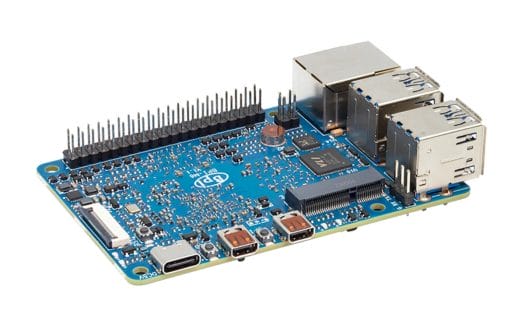
The Banana Pi BPI-M6 is a single board computer (SBC) that integrates the SenaryTech SN3680 SoC, which features a quad-core Arm Cortex-A73 processor, an Arm Cortex-M3 real-time core, an Imagination GE9920 GPU, and a Neural Processing Unit (NPU) capable of delivering up to 6.75 TOPS for AI tasks. This makes it an interesting choice for developers and enthusiasts interested in AI, for example.

The BPI-M6 comes equipped with 4GB LPDDR4 RAM and 16GB of eMMC flash storage, expandable up to 64GB. It offers a form factor and port layout reminiscent of the Raspberry Pi 4, including four USB ports, Gigabit Ethernet, a 40-pin GPIO header, a USB Type-C power port, and two micro HDMI ports. A standout feature is the provision of an HDMI input alongside the HDMI output, adding to its versatility.

Here are the detailed specifications of the Banana Pi BPI-M6:

  • SoC: SenaryTech SN3680 with:
    • CPU: Quad-core Arm Cortex-A73 processor up to 2.1GHz
    • MCU: Arm Cortex-M3 real-time security core @ 250MHz
    • GPU: Imagination PowerVR Series9XE GE9920 GPU
    • VPU: Supports 4Kp60 H265, H264, VP9, ​​VP8, AV1, MPEG-2 video decoding and dual 1080p60 H.264/VP8 video encoding
    • NPU: Up to 6.75 TOPS
    • Manufactured using a 12nm process
  • Memory: 4 GB LPDDR4
  • Storage: 16GB eMMC flash, expandable via microSD and SPI flash
  • Video & Audio Interfaces: Micro HDMI 2.1 output (4Kp60), MIPI DSI interface, Micro HDMI input
  • Networking: Gigabit Ethernet RJ45 port, optional WiFi via USB dongle
  • USB: 4x USB 3.0 ports
  • Expansion: M.2 Key E socket (PCIe + MIPI CSI), 40-pin header
  • Misc: SPI BOOT, UBOOT, Reset buttons, power and activity LEDs
  • Power Supply: 5V/3A via USB Type-C port
  • Dimensions: 92 x 60mm
  • Weight: 48 grams

Banana Pi provides support for Android and Ubuntu 20.04, along with a Linux SDK that includes Kernel 5.4 and Buildroot 2019.10. Despite showcasing impressive AI capabilities, the board’s NPU utilization is somewhat limited due to a lack of publicly available development tools from Synaptics for the Vivante VIP9000 NPU integrated within the SoC.

Source: CNX Software – Embedded Systems News.

Rockchip RK3568-Powered Asus Tinker Board 3N Comes in Three Variants

Rockchip RK3568-Powered Asus Tinker Board 3N Comes in Three Variants

ASUS has expanded its single-board computer (SBC) lineup with the introduction of the Tinker Board 3N, now available in three variants. The Tinker Board 3N series, powered by the Rockchip RK3568, offers options for various applications ranging from commercial to industrial uses. The base model, Tinker Board 3N, is designed for commercial temperature ranges, while the Tinker Board 3N Plus is suited for industrial temperature ranges (-40°C to 85°C). The Tinker Board 3N Lite offers a more budget-friendly option with reduced features.

Key specifications for the three variants include:

  • SoC: Rockchip RK3568 quad-core Arm Cortex-A55 processor @ 2.0 GHz, Arm Mali-G52 GPU, 0.8 TOPS NPU
  • System Memory: Options of 2GB, 4GB, or 8GB LPDDR4/LPDDR4X
  • Storage: Options include 32GB/64GB eMMC flash and MicroSD card slot, with additional NVMe SSD support via M.2 B-Key socket and 16MB SPI flash for the non-Lite versions
  • Display and Audio: HDMI with CEC, LVDS, eDP, 3.5mm headphone jack, stereo speaker header, and HDMI audio
  • Networking: Gigabit Ethernet, with varying support for Wi-Fi, Bluetooth, and 4G/5G connectivity depending on the model
  • USB: Multiple USB 3.2 Gen1 and USB 2.0 ports
  • Expansion and Miscellaneous Features: GPIO headers, serial interfaces, IR receiver, power-on & reset headers, among others

Pricing for the models starts at $169 for the Lite variant and goes up to $249 for the Plus version.

ASUS supports these boards with Debian 11 and Android 12 operating systems, offering resources like user manuals, schematics, and a qualified vendors list on the Tinker board website. Additionally, instructions for building the Linux image are available on GitHub.

Source: CNX Software – Embedded Systems News.

Armbian Releases OS Version 24.2 Kereru

Armbian Releases OS Version 24.2 Kereru

Armbian has announced the release of version 24.2, codenamed Kereru, introducing numerous improvements to enhance the user experience. Here are the key highlights of this release:

  • Resolved DNS resolution issues on Debian Bookworm
  • Optimized HDMI console performance on Khadas VIM1S and VIM4 devices
  • Streamlined Rockchip patch maintenance for improved stability
  • Expanded hardware compatibility with Xiaomi Mi10, OrangePi Zero 3, and ASUS Tinker Edge R
  • Implementation of the latest Amlogic kernel 5.15.y drop for Khadas VIM1S & VIM4 users
  • Introduced feature for displaying download links
  • Integrated Odroid M1 into the rockchip64 family
  • Added support for Ubuntu 24.04 Noble
  • Upgraded all current kernels to 6.6 LTS
  • Included Home Assistant extensions and security measures like LVM support and CRYPTROOT
  • Implemented cloud-init support and added support for Radxa Rock S0
  • Fixed network interface card failures on OrangePi One+
  • Resolved WiFi and Bluetooth issues on RockPi S devices caused by Edge Kernel
  • Addressed package removal and systemd unit enablement errors
  • Fixed desktop compatibility issues with Cinnamon desktop on Vim4
  • Optimized image loading times on Khadas VIM1S/VIM4 Bookworm

For a full list of actions, visit here.

Embedfire LubanCat 4 Card Computer: Rockchip RK3588S Dev Board with Mini PCIe Socket

Embedfire LubanCat 4 Card Computer: Rockchip RK3588S Dev Board with Mini PCIe Socket

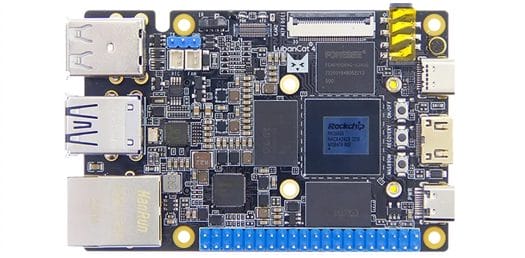
EmbedFire LubanCat 4 card computer, also known as LubanCat 4, is a feature-packed Rockchip RK3588S Single Board Computer (SBC) launched by Yehuo Electronic. This compact board measuring 85x56mm offers a wide range of functionalities, including Ethernet, USB, mini PCIe, HDMI 2.1, SIM card slot, microSD card holder, and more.

EmbedFire LubanCat 4 Specifications:

  • SoC: Rockchip RK3588S
    • CPU: Octa-core processor with 4x Cortex-A76 cores up to 2.2-2.4 GHz and 4x Cortex-A55 cores up to 1.8 GHz
    • GPU: Arm Mali-G610 GPU with support for OpenGL ES 3.2, OpenCL 2.2, and Vulkan 1.2
    • VPU: 8Kp60 video decoder and 8Kp30 video encoder
    • AI Accelerator: 6 TOPS NPU
  • System Memory: 4/8/16GB LPDDR4X
  • Storage: Options include no eMMC/32/64/128GB, microSD card socket
  • Video Output: Mini HDMI 2.1, 2x MIPI DSI connectors, USB Type-C interface supporting DP protocol
  • Networking: Gigabit Ethernet RJ45 port, optional WiFi or cellular mini PCIe module
  • USB Ports: 3x USB 2.0 Type-A interfaces, 1x USB 3.0 Type-A interface, 1x USB 3.0 Type-C interface
  • Expansion: Mini PCIe interface, 40-pin Raspberry Pi-compatible GPIO header
  • Misc: RTC battery connection socket, 5V fan header for cooling
  • Power Supply: 5V/4A DC input via USB Type-C
  • Dimensions: 85 x 56 mm

The board supports various operating systems including Android 13, Debian, Ubuntu, and ROS, all available on their GitHub repository. However, there is limited documentation available for the board at the moment.

The EmbedFire LubanCat 4 SBC is available for purchase on AliExpress with prices starting at around $110 for the 4GB RAM version without eMMC. This board offers a Raspberry Pi-sized solution powered by the robust Rockchip RK3588S SoC, making it a compelling choice for developers and enthusiasts looking to explore various projects in the server, Linux, DevOps, and home lab environments.

Source: CNX Software – Embedded Systems News.
Armbian Leaflet #17: Latest Updates to Armbian

Armbian Leaflet #17: Latest Updates to Armbian

Armbian, a popular Linux distribution for single-board computers (SBCs), has recently released a comprehensive update to enhance the user experience. The latest updates include improvements to the Armbian Build Framework, kernel upgrades, merging of Rockchip kernel families, and device-specific updates.

The Armbian Build Framework now includes official Github Action scripts, making it easier for users to re-compile images for their hardware. These scripts allow users to choose different configurations with or without customization. The framework can be accessed through the GitHub Marketplace.

Kernel upgrades have been completed for the current kernel selection, with the default upcoming kernel on most platforms now based on the most recent LTS kernel base 6.6.y. Additionally, EDGE kernels are already distributed with the latest 6.7.y.

Efforts are also underway to merge disassociated Rockchip kernel families, which will streamline maintenance and provide a more cohesive user experience.

In terms of device-specific updates, LicheePi 4A now has current kernel support, although it is still a work in progress (WIP). The old 32-bit Marvell kernel has also been successfully updated, ensuring that the popular NAS, Helios4, will continue to receive updates and maintainer support.

Several bug fixes and improvements have been made, including fixing a significant bug that affected network speed on RockPi S, applying numerous patches to address issues with display, wireless, Bluetooth, and DVFS on H616/H618 Zero2 and Zero3 series, and changing the default CPU governor to schedutil to optimize performance and responsiveness.

Waveshare Releases PoE HAT+ Kit, the PoE HAT(F)

Waveshare Releases PoE HAT+ Kit, the PoE HAT(F)

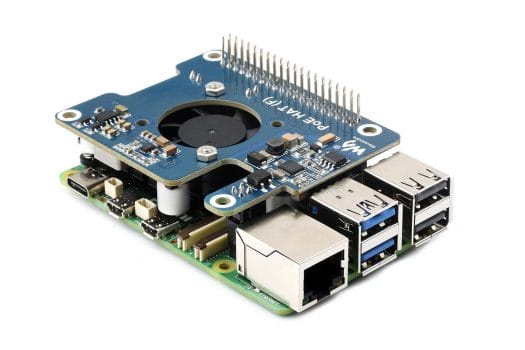
Waveshare has released the PoE HAT(F), an 802.3af/at-compliant 24W Power-over-Ethernet (PoE) board designed for the Raspberry Pi 5. This HAT also includes a cooling solution for the SBC, featuring an embedded fan, a heatsink, and two thermal pads.

The Waveshare PoE HAT(F) features the following specifications:

  • Connection: 40-pin Raspberry Pi GPIO header and 4-pin PoE header
  • PoE (Power Over Ethernet):
    • IEEE 802.3af/at compliant
    • Input voltage: 37V-57V DC input
    • Output:
      • 2-pin header: 12V/2A max
      • GPIO header: 5V/4.5A max
  • Fully isolated switched-mode power supply (SMPS)
  • MP8759GD buck converter chip
  • Cooling: Fan, metal heatsink, and thermal pads for heat dissipation
  • Dimensions: 70 x 56.5 mm

The Waveshare PoE Hat(F) is currently available for purchase on Amazon, AliExpress, and on Waveshare’s online store.

Source: CNX Software – Embedded Systems News.