Posts for: #single-board-computer

Radxa X2L: Affordable Celeron J4125 SBC

Radxa X2L: Affordable Celeron J4125 SBC

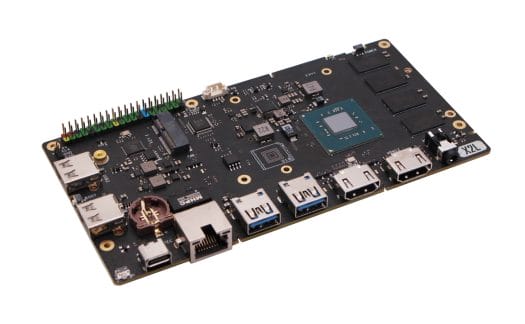
Radxa has released the X2L, an affordable single-board computer (SBC) powered by the Celeron J4125 Gemini Lake Refresh processor. The X2L comes with 2GB to 8GB of RAM, an M.2 socket for SSD storage, and another M.2 socket for a wireless module. It also offers a variety of ports, including dual HDMI, gigabit Ethernet, four USB ports, and a 40-pin GPIO header.

Specifications of the Radxa X2L include:

  • Celeron J4125 quad-core Gemini Lake Refresh processor
  • Raspberry Pi RP2040 microcontroller for GPIO control
  • 2GB, 4GB, or 8GB LPDDR4 RAM
  • 1x M.2 M-Key socket for NVMe SSD storage
  • Optional 32GB eMMC flash
  • 2x HDMI ports
  • 3.5mm headphone jack with microphone input
  • Gigabit Ethernet port
  • Optional WiFi and Bluetooth module
  • 2x USB 3.0 Type-A ports, 2x USB 2.0 Type-A ports
  • 40-pin GPIO header
  • M.2 M-Key socket for NVMe SSD
  • M.2 E-Key socket for wireless module
  • RTC battery socket
  • 4-pin header for PWM fan
  • 3-pin debug header
  • Power button, BOOTSEL button, clear CMOS button, and user button
  • 12V/2A power supply via USB-C port
  • Dimensions of 155 x 80 x 10 mm
  • Temperature range of 0 to 50°C
  • Certifications include FCC and CE

The Radxa X2L is available for purchase starting at $39 on Arace and AllNetChina. This price is for the model with 2GB of RAM. Users will need to add an M.2 SSD and a USB PD power supply. The 8GB model with a 32GB eMMC flash is also available for $79.

Source: CNX Software – Embedded Systems News.

Firefly EXT-2.5GE-RK3588-RT: Quad 2.5GbE Ethernet Expansion Board for ROC-RK3588-RT SBC

Firefly EXT-2.5GE-RK3588-RT: Quad 2.5GbE Ethernet Expansion Board for ROC-RK3588-RT SBC

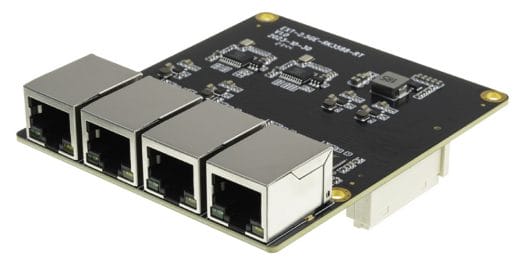
Firefly has launched the EXT-2.5GE-RK3588-RT, a 2.5GbE Ethernet Expansion Board for the ROC-RK3588-RT Rockchip RK3588 SBC. The ROC-RK3588-RT SBC already features three Ethernet ports, making it ideal for routers and firewalls. The EXT-2.5GE-RK3588-RT adds four more 2.5GbE ports to the SBC, bringing the total number of Ethernet ports to seven with five 2.5GbE and two GbE RJ45 jacks. The board uses the RTL8125BG IC for Ethernet control and the PI6C557-05 IC as a spectrum clock generator.

Source: CNX Software – Embedded Systems News.

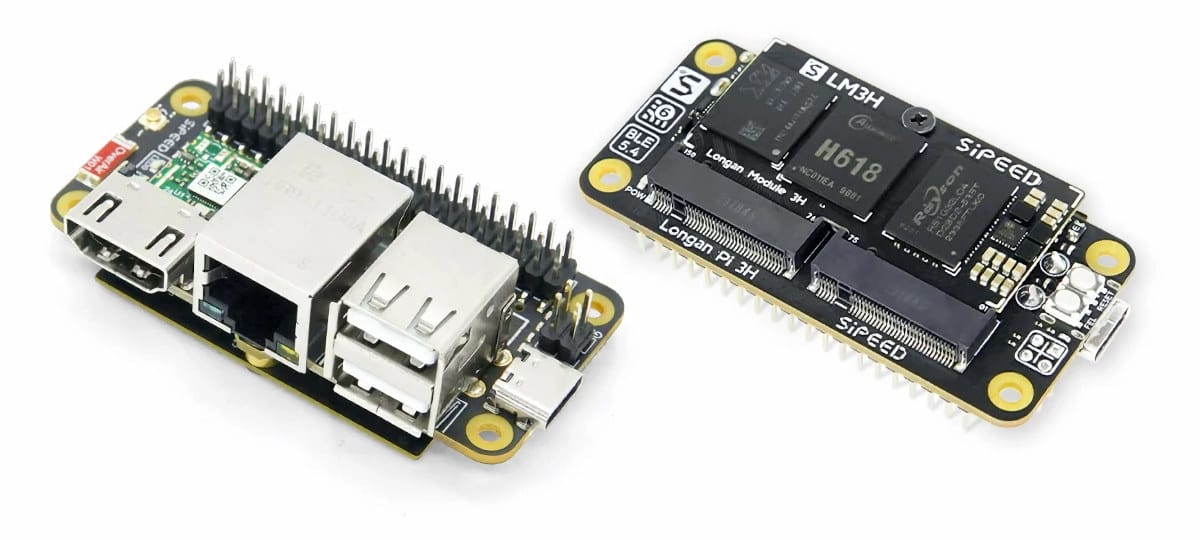
The Sipeed Longan Pi3H: A Compact Board with Gigabit Ethernet, WiFi 6, HDMI, and USB

The Sipeed Longan Pi3H: A Compact Board with Gigabit Ethernet, WiFi 6, HDMI, and USB

Sipeed has introduced the Longan Pi3H, a single board computer (SBC) that is similar in size to the Raspberry Pi Zero. Powered by an Allwinner H618 quad-core Cortex-A53 processor, the board features full-size connectors including an HDMI 2.0 video output, two USB 2.0 Type-A ports, and a gigabit Ethernet RJ45 jack. It also offers WiFi 6 and Bluetooth 5.4 connectivity, a 40-pin GPIO header, and a USB OTG Type-C port for power. The board is composed of a carrier board and a replaceable LM3H CPU module with the Allwinner H618 SoC, RAM, and eMMC flash.

The Sipeed Longan Pi3H specifications include:

  • SoC – Allwinner H618 with a quad-core Arm Cortex-A53 processor, up to 1.5GHz, and 1MB L2 cache
  • GPU – Arm Mali-G31 MP2 GPU with support for OpenGL ES 1.0/2.0/3.2, OpenCL 2.0, Vulkan 1.1
  • VPU with support for various video formats
  • System Memory – 2GB or 4GB LPDDR4
  • Storage options include a microSD card slot and optional 32GB eMMC flash
  • Video & Audio Output – HDMI 2.0a up to 4Kp60
  • Networking features a gigabit Ethernet RJ45 port and dual-band WiFi 6 and Bluetooth 5.4 with a ceramic antenna
  • USB ports include 2x USB 2.0 Type-A ports and 1x USB 2.0 OTG Type-C port
  • Expansion options include a 40-pin Raspberry Pi-compatible GPIO header with I2C, SPI, UART, and a variety of GPIOs
  • Debugging features a 4-pin debug UART (3.3V)
  • Additional features include FEL and Reset buttons, 2x user LEDs
  • Power supply options include 5V via USB Type-C port or 4-pin Debug UART header
  • Dimensions: SBC – 65 x 30.8 x 23.6 mm, LM3H module – 46.1 x 25 x 2.9mm

Mainline Linux support for the board is expected to be merged in Q1 2024. While the documentation page is not currently working, hardware documentation such as schematics and mechanical drawings are available.

Pre-orders for the Sipeed Longan Pi3H are available on Aliexpress, with prices ranging from $17.90 for the 2GB RAM variant (without eMMC flash) to $34.90 for the 4GB RAM variant with 32GB eMMC flash. Shipping is expected to start on February 11, and the product will be available for European customers in a few days.

Source: CNX Software – Embedded Systems News.

Youyeetoo R1: RK3588S SBC with NFC and M.2 Sockets at an Affordable Price

Youyeetoo R1: RK3588S SBC with NFC and M.2 Sockets at an Affordable Price

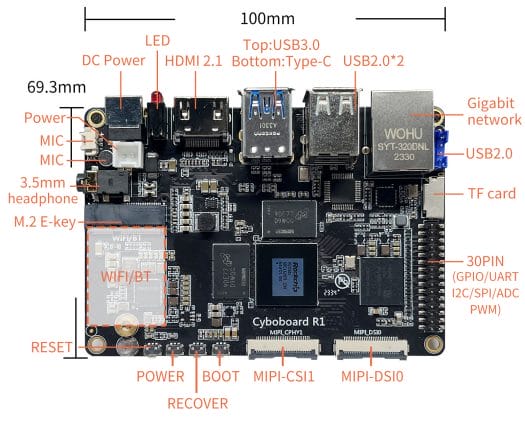
Youyeetoo has released the Youyeetoo R1, a feature-rich single-board computer (SBC) powered by the Rockchip RK3588S. The compact 100×69.3mm board offers two M.2 sockets for NVME/SSD or 4G LTE, a WiFi and Bluetooth connector, NFC support, four display interfaces, and two MIPI CSI camera interfaces.

The Youyeetoo R1 comes with various configuration options, including up to 32GB of RAM and 256GB of eMMC flash. The board also features a gigabit Ethernet port, five USB interfaces, a built-in microphone, multiple audio inputs/outputs, a 30-pin header for expansion, and HDMI input via an adapter connected to one of the MIPI CSI ports.

Specifications:

  • SoC: Rockchip RK3588S with octa-core processor (4x Cortex-A76 cores @ up to 2.2-2.4 GHz, 4x Cortex-A55 cores @ up to 1.8 GHz), Arm Mali-G610 GPU, 8Kp60 video decoder, and 6 TOPS NPU for AI acceleration
  • System Memory: 4GB, 8GB, 16GB, or 32GB LPDDR4x
  • Storage: 32GB, 64GB, 128GB, or 256GB eMMC flash, M.2 M-Key socket for NVMe or SATA SSD, MicroSD card socket
  • Video Output: HDMI 2.1 port up to 8Kp60 or 4Kp120, 2x MIPI DSI connectors up to 4Kp60, USB Type-C with DP1.4 support up to 8Kp30
  • Video Input: 2x 4-lane MIPI CSI connectors, optional HDMI input via RK628D adapter board
  • Audio: 3.5mm earphone jack with microphone, digital audio output via HDMI, on-board microphone, 4-pin header with R/L/GND/MIC, 2-pin header for microphone
  • Networking and connectivity: Gigabit Ethernet RJ45, M.2 E-Key socket for WiFi 5 and Bluetooth 5.0 module or WiFi 6 and Bluetooth 5.2 module, M.2 M-Key socket for 4G LTE module, NFC via external antenna
  • USB: 1x USB 3.0 Type-A port, 2x USB 2.0 Type-A ports, 1x USB 3.1 OTG Type-C port with DisplayPort Alt mode, 4-pin header with USB 2.0 interface
  • Expansion: M.2 2242 M-Key socket for PCIe/SATA SSD or 4G LTE module, M.2 2230 E-Key socket for WiFi & Bluetooth module, 30-pin GPIO header with various I2C, UART, CAN, PWM, ADC, SPI, and GPIO signals
  • Debugging: Debug UART connector
  • Misc: Power, Recovery, Reset, and Boot buttons, 2x red/green user LEDs, RTC battery connector, fan connector
  • Power Supply: 12V/3A via 5.5×2.1mm DC jack or 2-pin socket
  • Dimensions: 100 x 69.3 mm

The SBC supports Android 13, Debian 11, Ubuntu 22.04, and Buildroot, all based on Linux 5.10. The documentation for the board is still being developed, but previous reviews of Youyeetoo products have shown decent documentation quality.

The Youyeetoo R1 will be available at $99. Higher configuration options such as 8GB/64GB are available. 16GB/128GB and 32GB/256GB models expected to be released in the future.

Source: CNX Software – Embedded Systems News.

Raspberry Pi Unveils PCIe FFC Connector and New HAT+ Specifications

Raspberry Pi Unveils PCIe FFC Connector and New HAT+ Specifications

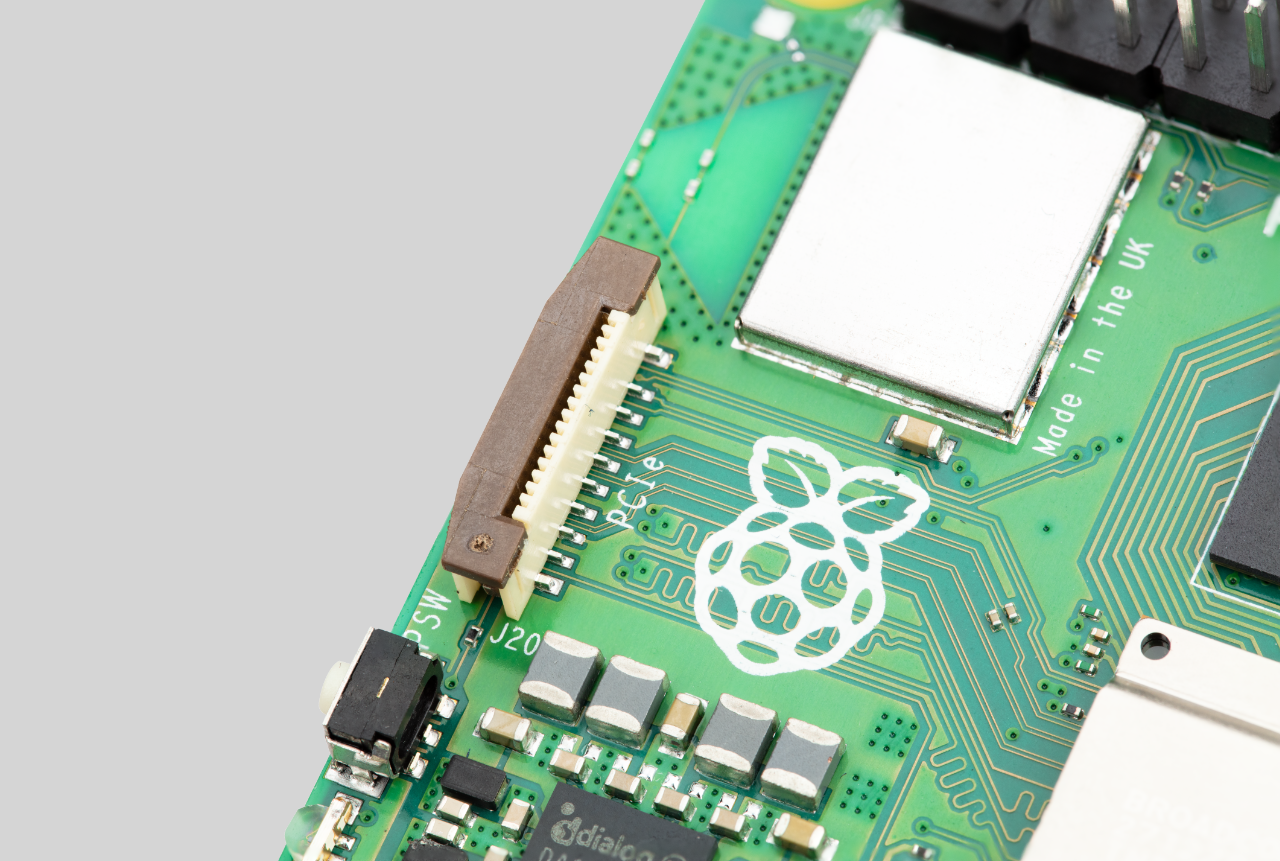
One of the most notable features of the new Raspberry Pi platform is its small, vertical, 16-way FFC (Flat Flexible Cable) connector on the left-hand side of the board. This connector exposes a single-lane PCI Express interface.

The Peripheral Component Interconnect Express (PCI Express or PCIe) is a board-level interconnect that enables high-speed data transfer between a processor chip and external peripherals such as NVMe SSDs, Ethernet cards, and AI/ML accelerators. PCIe achieves this by serializing data transfers and sending one bit at a time down a single channel. Each channel consists of one or more differential pairs on the PCB, which are controlled waveguides made by closely spaced wires. In the case of a single-lane PCIe interface, there is a single transmit pair, a single receive pair, and a clock pair, requiring three differential pairs and six wires. The Raspberry Pi 5, based on the BCM2712 processor, is connected to the RP1 I/O controller via an ×4 interface.

The PCIe specification also requires sideband signals such as reset, clock request, and wakeup. The 16-way connector on the Raspberry Pi provides all these signals, along with two pins for controlling board power and automatically detecting a properly designed PIP (PCIe Peripheral) by the Raspberry Pi firmware.

Instead of adding an M.2 connector to the Raspberry Pi 5, which would be large, relatively expensive, and require a 3.3V, 3A power supply, the Raspberry Pi team opted for a small, low-cost FFC connector. This allowed them to provide a PCIe interface without increasing the board size or imposing additional costs on users.

At the launch of the Raspberry Pi 5, the team did not have a specification for building peripherals that attach to the 16-way PCIe connector. They wanted to thoroughly test their own prototype product and consider the interaction of PCIe peripherals with Raspberry Pi power states and firmware. They have now released the first revision of the specification and are in the final stage of prototyping their own M.2 M Key HAT+. This HAT+ will be launched early next year.

In addition to the PCIe connector specification, the Raspberry Pi team has also released a preliminary version of the new HAT+ specification. The original HAT specification, written in 2014, is in need of an update. The new specification simplifies certain aspects, including the required EEPROM contents, and consolidates everything into one document. It also adds new features. While there is still work to be done on this standard and the EEPROM utilities have not been updated, this release provides a glimpse into the changes in the HAT standard.

The Raspberry Pi team wanted to ensure that the HAT+ standard is developed correctly, as it is expected to be in use for as long as the old HAT standard. They believe that PCIe boards (PIPs) that go on top of the Raspberry Pi should be HAT+ boards, and their own M.2 HAT+ will adhere to this standard.

More information can be found in the first revision of the Raspberry Pi Connector for PCIe datasheet, and the Raspberry Pi HAT+ Specification datasheet.
Radxa ROCK 3B: Fusion of Pico-ITX and Raspberry Pi Form Factors

Radxa has released the ROCK 3B, a “PI-CO ITX” single-board computer (SBC) that combines the benefits of Pico-ITX and Raspberry Pi form factors. The board, measuring 100x72mm, features all main ports on the rear side and supports expansion through a 40-pin Raspberry Pi-compatible GPIO header and several M.2 sockets for storage and wireless modules. The ROCK 3B is the larger brother of the ROCK 3A, a business card-sized SBC introduced in 2021. Both boards are powered by the Rockchip RK3568 SoC and support up to 8GB LPDDR4. The ROCK 3B features two gigabit Ethernet ports, an M.2 B Key socket for 4G LTE/5G cellular modules, an M.2 PCIe 3.0 x1 socket for an M.2 2280 SSD, and an M.2 Key-E socket for WiFi 6.

The specifications of the ROCK 3B include:

  • SoC: Rockchip RK3568 (J)
    • CPU: Quad-core Cortex A55 processor at up to 2.0 GHz
    • GPU: Mali G52 GPU with support for OpenGL ES 1.1/2.0/3.2, OpenCL 2.0, Vulkan 1.1
    • VPU: 4Kp60 H.264/H.265/VP9 video decoder, 1080p60 H.264/H.265 video encoder
    • AI accelerator: 1 TOPS NPU; INT8/INT16/FP16/BFP16 MAC hybrid operation; support for TensorFlow, TF-lite, Pytorch, Caffe, ONNX, MXNet, Keras, Darknet
  • System Memory: 2GB, 4GB, 8GB LPDDR4
  • Storage: Pluggable eMMC module, MicroSD card slot, M.2 M key socket for NVMe with PCIe 3.0 x2
  • Video Output: HDMI 2.0 port up to 4Kp60, 2x MIPI DSI connectors (4-lane and 2-lane), eDP connector, Touch Panel connector
  • Camera: 1x MIPI CSI connector
  • Audio: 3.5mm audio jack, digital audio via HDMI
  • Connectivity: 2x Gigabit Ethernet ports, WiFi 6 via M.2 E key socket with PCIe 2.0 x1/SDIO/UART, 4G LTE/5G cellular via M.2 B key 3042 socket with PCIe, SATA, USB interfaces, and a SIM card socket
  • USB: 2x USB 2.0 ports, 2x USB 3.0 ports (1x OTG+1x HOST)
  • Expansion: Color-coded 40-pin GPIO header mostly compatible with ROCK Pi 4 and Raspberry Pi 3/4, exposing 5x UART, 1x SPI, 2x I2C, 1x PCM/I2S, 1x CAN bus, 6x PWM, 1x ADC, 6x GPIO, 1x USB 2.0, and 5V, 3.3V, and GND power signals
  • Misc: RTC with connector for backup battery, IR receiver, RGB LED, Fan header, Power and recovery buttons
  • Power Supply: 6V to 20V DC via USB-C port with USB PD 2.0, QC 3.0, or fixed voltage support, 5V via GPIO pin 2 or 4
  • Dimensions: 100 x 75 mm (Pico-ITX and PI-CO ITX form factors)
  • Certifications: CE/FCC

The Rock 3B was first unveiled in 2021 with a slightly different design, which was modified based on user feedback. The board is now available for purchase, with prices starting at $45 for the 2GB RAM version, $55 for the 4GB RAM version, and $75 for the 8GB RAM version on Arace Tech. However, it may be challenging to find compatible accessories as the website’s accessories section is not clear, and some accessories are missing.

Source: CNX Software – Embedded Systems News.