Posts for: #usb

Tillitis Tkey: An Open-Source USB-C RISC-V Security Key

Tillitis Tkey: An Open-Source USB-C RISC-V Security Key

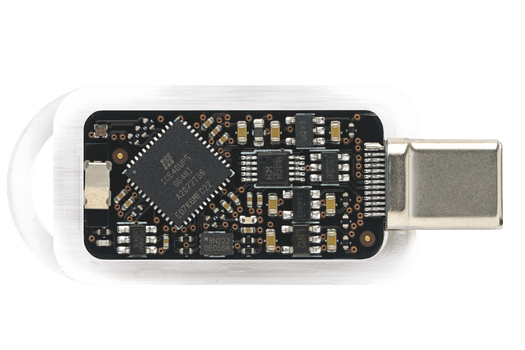
The Tillitis TKey is a unique USB-C security key based on a 32-bit RISC-V core, specifically the PicoRV32, housed in a Lattice iCE40 UP5K FPGA. Described as a “new type of flexible USB security token,” it draws inspiration from DICE (Device Identifier Composition Engine) and measured boot technologies. Unlike traditional security keys with persistent onboard storage, the TKey relies on loading apps onto the key each time it connects to a host device. This method, employing measured boot, generates a distinct identifier for each application, enhancing security by avoiding the storage of private keys on the device. Both the hardware and software for the TKey are entirely open-source, ensuring trustability. Developed by Tillitis, a Swedish security firm, the TKey has two versions: locked and unlocked. The locked version, targeting general users, is not reprogrammable, while the unlocked version allows full configuration using the Tillitis TK Programmer, based on a Raspberry Pi Pico, for added flexibility. Tillitis specializes in hardware trust products and emerged as a separate entity from the Mullvad VPN company in 2022.

Specifications:

  • Processor:
    • 32-bit RISC-V PicoRV32 core @ 18 MHz
    • FPGA: Lattice iCE40 UP5K
    • 128 KiB RAM for TKey device application
    • 2 KiB RAM for firmware
    • 6 KiB ROM
    • Execution monitor
    • RAM protection
  • Connector: USB-C
  • Hardware Privilege Modes: Firmware mode and application mode
  • Misc: Touch sensor, power indicator, status indicator
  • Input voltage: 5V
  • Max current consumption: 100mA
  • Operating temperature: 0°C – 40°C

The Tillitis TKey RISC-V security key can be purchased from the Tillitis shop. The end-user version and the advanced user version are priced at 880 Swedish kronor (about $90), while the programmer is priced at 500 Swedish kronor (around $50).

Source: CNX Software – Embedded Systems News.

COM-HPC 1.2 Specification Unveiled: Introducing COM-HPC Mini 95x70mm Form Factor

PICMG has announced the release of the COM-HPC 1.2 specification, which includes the new COM-HPC Mini form factor. This form factor, about the size of a credit card at 90x75mm, provides access to high-speed interfaces such as PCIe Gen5, USB4, and 10GbE.

The COM-HPC Mini form factor is a smaller version of the COM-HPC standard, designed for applications like autonomous mobile robots, drones, and mobile 5G test and measurement equipment. It offers a compact solution for edge computing.

The COM-HPC 1.2 “Mini” modules come with a single 400-pin connector and various interfaces, including storage with 2x SATA ports (shared with PCIe lanes), display with 1x eDP and 2x DDI, networking with 2x 10 Gbps NBASE-T Ethernet ports, USB with 8x SuperSpeed lanes for USB4/ThunderBolt or USB 3.2, 8x USB 2.0, PCIe with 16x PCIe lanes supporting PCIe 4.0 or PCIe 5.0, and miscellaneous features such as boot SPI and eSPI, UART, CAN, Audio, FUSA, and power management signals.

The COM-HPC Mini modules support cameras via an FFC connector with a MIPI CSI interface. The input voltage ranges from 8V to 20V DC, and the modules can handle up to 107W of input power. The dimensions of the modules are 95 x 70 x 15 mm.

While the COM-HPC 1.2 specification has been released and is available for download, it comes at a cost of 750 Euros. The information provided above is based on a press release, as access to the specification is required to obtain further details.

It is unclear when companies like congatec or ADLINK will release actual COM-HPC Mini modules. However, PICMG plans to release a “COM-HPC 1.2 Carrier Design Guide” in early 2024, suggesting that announcements may be expected later in the first half of 2024.

Source: CNX Software – Embedded Systems News.

Thunderbolt 5 to Offer 120 Gbps Bandwidth, Ideal for High-Speed Storage

Intel has recently announced Thunderbolt 5, the latest iteration of their high-speed connectivity technology. With up to 120 Gbps bandwidth when using “Bandwidth Boost,” Thunderbolt 5 offers significant improvements over its predecessor.

The key features of Thunderbolt 5 include:

  • 80 Gbps of bi-directional bandwidth, with the option to boost it to 120 Gbps for video-intensive usage.
  • Double the PCI Express data throughput, resulting in faster storage and external graphics performance.
  • Compatibility with USB4 V2, DisplayPort 2.1, and PCI Express Gen 4.
  • Double the bandwidth of Thunderbolt Networking for high-speed PC-to-PC connections.
  • PAM-3 signaling technology that enhances performance with existing circuit boards, connectors, and passive cables up to 1 meter.

Thunderbolt 5 is aimed at meeting the needs of content creators, gamers, and professionals who require high-speed connectivity. While it may take some time for Thunderbolt 5 to become prevalent in mini PCs, its adoption is expected to increase as the demand for faster storage and high-performance eGPU grows.

Premium PCs and laptops are likely to integrate Thunderbolt 5 soon, as Intel’s controller, codenamed Barlow Ridge, is set to be available in 2024.

For storage enthusiasts and those building home servers, Thunderbolt 5 offers an exciting prospect. Its increased bandwidth and compatibility with USB4 V2 make it a suitable choice for high-speed data transfer and storage solutions. Additionally, Thunderbolt 5’s ability to support multiple 8K monitors opens up possibilities for multi-display setups in server or network environments.

It’s worth noting that Thunderbolt 5’s potential for storage extends beyond traditional setups. For instance, AWS has adopted Thunderbolt for their Apple Silicon Mac mini datacenter offering, utilizing its capabilities for high-speed storage.

For more detailed information on Thunderbolt 5, refer to Intel’s press release and the product page.

Source: CNX Software – Embedded Systems News.